Wednesday, May 28, 2008

Black Dice

Black Dice feature in Self-Titled Magazine

Late summer of last year, I was asked by the editors at Devil in the Woods Magazine to write the "definitive" article on Brooklyn's Black Dice. Oddly maligned now by the cognoscenti (a colleague at Pitchfork once lamented that after Beaches & Canyons they moved away from sounding like the Boredoms, which is really fucking unfair) and forever in the shadow of a band they helped nourish, Animal Collective, I undertook the task of recasting the group. Read for yourself to see if it was successful.

The article involved a series of one-on-one interviews with Bjorn and Eric Copeland and Aaron Warren, as well as ousted drummer Hisham Bharoocha. I also talked to Catsup Plate Records founder Rob Carmichael, DFA label boss Jonathan Galkin, the Animal Collective's Avey Tare, and world-renowned artists Richard Phillips and Doug Aitken. In retrospect, I wish that I had talked to videographer Danny Perez, Gore co-author Jason Frank Rothenberg, and old bassist Sebastian Blanck, but I was already neck-deep in tape.

Having finished the exhaustive piece, easily the largest article I've ever written for a magazine, I went away on holiday to the other side of the world. Upon my return to NYC, the article still hadn't seen daylight. DiW instead had molted into a new entity, Self-Titled, some weird amalgam of online and print that I have yet to figure out. What I do know though is that said Black Dice article is now seeing some day/ pixel light. The editors keep assuring me that they'll be submitting it for Da Capo's Best Music Writing, but that's neither here nor there, I'm just glad that it exists. (Seriously though, stuff that ballot box come November.)

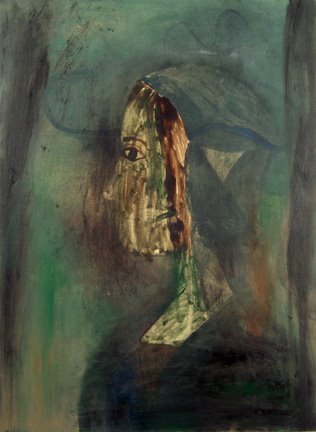
Usually, I post all relevant interview transcripts here, but for once, the canvas provided by DiW/s/t was large enough to capture nearly every nuance and grace note (which I remain grateful for), so rendering the transcripts here ultimately feels redundant. That said, I am posting below the words from Doug Aitken and Richard Phillips, since both gents were kind enough to take time out of their busy schedules to speak with me, a true honor. At the last moment, all of Doug Aitken's comments were excised and Richard Phillips (who was gracious enough to let me use the above image for this post) had many more illuminating points to make about the art world at large. Enjoy.

Richard Phillips

"I saw them live early on. A friend of mine brought me to some club in Brooklyn. It was a night they played with Wolf Eyes, an all out noise-fest. When I saw Black Dice it was a complete paradigm shift. It was just a really all-out assault, a terrific show. Wolf Eyes were also quite powerful in a more tribal way. When I saw them again at another point, I took Doug to see them at a loft party in Brooklyn. I was struck by the commitment to this form that was completely…it was really had broken free and was original in its aggression and assault. It was a new form. I was preparing the exhibition concurrently and was inspired by them while painting.

"I ended up speaking with Bjorn, Hisham, Aaron and Eric and organized a studio visit. I thought it would be perfect to have them perform at my opening. A 140 decibel all-out assault that they do be happening during the opening for my exhibit entitled “America.” Which dealt with different ways, issues surrounding individuals sovereignty, individuals relationship to power. A huge painting of Bush, with pink panels.

"I just felt the show was as much about negation of that power as much an affirmation. The way in which their music I felt was did have this … application of negation as a way of making music, something I identified with. They did a two-part piece, two half-hour long pieces, solely for that show. They performed at absolute top volume. We provided a huge bowl of ear plugs and they were gone in 15 minutes. This was a night of openings at Chelsea Piers and a lot of it for me was to end the glad-handing, social aspect of openings, where it just becomes a way to advance ones career and I wanted to take the whole idea of discussion and interaction completely out of it. The sound would completely annihilate that potential and that it would be really about being in the space with them and these paintings at a certain point in time. and to cause a break in the trajectory of Chelsea and the arts scene, to really detonate a response to this kind of formulaic traipsing around. They had come over and seen the paintings. It was a statement of purpose. The timing of it…to have this kind of event. 9/11 was uncanny, horrific.

"In sense of collaboration, it was one of the more successful ones I ever worked with. It stands to me as a real singular moment in time. I honestly feel it was a summation. It’d be difficult to repeat. It was before their work became more lyrical and melodic in a sense. It was a culmination of things. I knew what they were capable of. The show was no less violent. It was really a breaking point, a real outpouring of energy and intensity and I felt that way in the run up to the show. There was a kind of abject nature, a negation, not in a punk way. What I really felt about Black Dice they absolutely annihilated agreements/ disagreements. The sheer sonic force blew threw the whole thing. The environment, there was a lot of people in the art community as well. You could hear them from blocks away. There was a huge crowd, hundreds and hundreds of people.

"What I wanted to do was have the gallery and those images become a nucleus for a kind of change. We didn’t have any possible…it was as important as the paintings. It was absolutely integral. That sense of the sound at such an extreme level and it being a culmination of those earlier performance. I was surprised how things changed. I watched their most recent video, it has a dance feeling to it. I really liked it a lot. I really responded to it. I felt the work they were doing at that time was really on it and leading in an important direction, regardless of their discipline. I really identified. It was really of the moment. What could’ve been a better expression of that time? It was more prophetic than we could’ve ever imagined."

Doug Aitken

"Richard Phillips was telling me I should check Black Dice out when they were playing in Williamsburg. You have to listen to your friends to get a lead on some things. It was a physical experience, it’s not so much a sonic experience. That was the thing about BD that impressed me. You could stand there and there was this really heavy bio-rhythm moving through your body that came through the sound.

"The thing that struck me was the idea that there’s something very much a raw white noise wall that you’re confronted with, a sonic assault. The deeper you’re in it, you start pulling up these delicate rhythms and frequencies and repetitions. That’s what makes Black Dice complex musicians. They’re able to harness and create something repetitious, hypnotic, that makes me think of Riley, Reich, Young. Merging that with a VU white noise quality. They’re just a couple of guys. It’s unpretentious, a pretty raw, dirty feeling, very honest and direct.

"I did this happening two years ago with them. Sometimes you feel like you’re inside a speaker cabinet when you see them play. It’s so small and tight, crushing and compacting inside your mind. On a personal level…(like the artist masturbating under the floor) Black Dice plays, very similarly, getting at you and getting in you and shifting your perceptions. That’s really interesting, these ties to avant-garde art sensibilities. It’s still more of a sonic experience for me personally, but I love that book of collages, Gore. It’s just fresh, people doing what they want to do."

Tuesday, May 20, 2008

Tom Lee Interview


Continuing to post interviews relevant to the Arthur Russell article that ran last week at the Voice, coinciding with a series of tribute concerts. At the Friday night concert, I finally had the pleasure of meeting Tom Lee, Arthur's longtime live-in boyfriend and the man who bears the herculean task of keeping Arthur's legacy extant in the physical world. I sent him a set of questions and received this as his reply:

I was very excited when Matt wrote to me about making a film about Arthur. I remember that I was away for the summer and was very enthusiastic about meeting with him when I returned that September. His letter was direct and a little formal…very respectful, as is Matt’s demeanor. When we met he had a variety of ideas that really interested me because he wanted to create something that was not a ‘typical’ looking documentary. I right away thought that it will be interesting for a person of a different generation, who was not a witness of Arthur’s times, to make this film. I also was aware that there was not very much footage of Arthur performing and I remember being a little concerned that Matt might be discouraged when he discovered that. To his great credit he not only used what I knew to be available but on his own and working along with Steve Knutson from Audika Records he was able to unearth some archival footage of Arthur performing.

When Point Music came forward right after Arthur died and catalogued and put together “Another Thought” I was very pleased that this would be a tribute to Arthur’s work. It showcased a good variety of his music and yet I was still at that time holding out hope that a bigger release would still follow. Arthur was always in touch with Geoff Travis at Rough Trade and I think he and I thought that his strongest songs would be released by Rough Trade. He liked Geoff a great deal and Geoff was always supportive…emotionally and financially. Even though it didn’t happen during his life I was still sure that it would after he died. I was a little disappointed that “Another Thought” did not create any sparks of interest.

Of course it is a little bittersweet that it took until many years until after Arthur died for his music to appeal to so many people. People have somewhat mythologized Arthur’s methods and practices…never being quite satisfied with a song, creating many versions of the same song, adding and subtracting a variety of drums, keyboards, horns, etc., but at the same time there were a few very profound factors involved. On one hand the musicians and studios that he worked with would often change…people got steadier gigs, moved on and out of the city, began to work with other people; he would present his music to many different people in the music business, hoping to hear an encouraging word back from them but of course one can’t control that; and of equal or greater importance is that as he kept to practicing at Westbeth, listening to endless takes on his Walkman, scheduling recording sessions on the days and nights of the full moon, arranging gigs at Experimental Intermedia Foundation, The Alternative Museum, La Mama, etc.; he was concurrently attending to an amazing amount of health issues.

AIDS was so complex at that time that even as he followed various regimens of treatments he would often be fighting malaise and fatigue and at the same time be afflicted with any number of opportunistic illnesses that hiv and the medicines might produce. He was heroically moving forward in spite of all of this. All of this work does not automatically lead to acceptance and success and that certainly did not seem to be what Arthur was counting on. I almost think he was courting that idea so that he might get some more money to pore into more studio time to keep going on with his next idea!

After Arthur died it was very hard for me not to continually play various songs to my friends and family. It got so that I could just imagine hearing “Wild Combination/That’s Us” on the radio, where I still feel that it should be heard. I was so wrapped up in every nuance of his music. I was revisiting and re-discovering his music in an almost fanatical way. I have dozens of favorite songs and I tease out my own meanings for slight phrases in certain songs….as I remember him calling me at work to ask when I would be home, or hopping on my bike after a breakfast together in the East Village. I can so clearly remember how much fun he had with the song, “Hop On Down To Petland”. As with many of his songs he wanted it to appeal to young kids and that is often what he strove for with certain songs. I also fell in love with the tender songs of “World Of Echo” after he died. I would just get carried away listening to all the various versions on tape of that record…and the songs that were left off the record, a few of which Steve Knutson included on the re-issue of that album on Audika. It is always a part of my life and there isn’t any way to put it aside.

The idea of “moving on” has taken on a certain meaning because I have been a caretaker of Arthur’s legacy and as people became interested they would be referred to me by others. This also would lead them to the musicians that Arthur played with over the years. (I would be happy to make a list but to save some time here I will wait until you say you need some names of those folks.) In the years that followed the release of “Another Thought” people would periodically contact me about releasing some of Arthur’s music. I would make them compilation tapes of my favorites but they mostly wanted to re-release the dance tracks to test the waters before they would commit to previously unreleased music.

Happily, Steve Knutson contacted me and he was the first person willing to take a chance on releasing some of Arthur’s music that was not known. I was long waiting for someone to take a chance and let people hear the music I was so in love with. The record, Calling Out Of Context, presents some of Arthur’s great songs. (A personal favorite of mine is “Platform On The Ocean”, which I did not think anyone would release. It is so hypnotic to me and as Arthur was creating it he would give me ninety minute tapes of that song to listen to on my Walkman and then as I returned to our apartment we would discuss it and together make edits of it. It was the one song of his that I actually spliced and taped versions of!) Steve has been a fantastic steward and caretaker of Arthur’s music. Arthur’s family and I are so grateful for all that he has done.

The reason that I am so close to Arthur’s family, his parents, Chuck and Emily Russell, and his sisters, Julie and Kate, is that they are such amazing people. Under different circumstances we might have lost contact over the years, but I just love them like my own family. I grew to know Kate and Julie quite well when Arthur was sick and they would visit a few times over his last few years. With his parents calls from Iowa we gradually got to know each other and their support and concerns were so heartfelt. It was such a worrisome time that often it was about comforting, reassuring, informing and consoling one another. Along the way we discovered common interests and we continue to have strong friendships with each other. We have helped each other try to understand who Arthur was during his time on this earth and how our time with him has impacted our lives. We also move on and share a lot of time together during the summer in Maine.

In terms of your last question, Arthur looking for a hit, perhaps we could talk that out a bit. I think that it is complicated. He did not purposely go from project to project because one failed to produce a ‘hit’. He stayed with bands and groups for awhile….The Flying Hearts, The Sailboats, The Necessaries, but would move on as things did not catch on. He would at the same time keep working the ‘dance’ scene and there it was a constant education for him. What are the new ‘beats’, who are the hottest re-mixers, how did a group achieve that ‘sound’ on their record? And as he was considering all that he was trying to think up a new catchphrase to build a song around, such as: “new shoes on my feet…I want to tell you today,” or “wax the van,” or “let’s go swimming!” I’ve called theses songs his ‘call to action’ songs. As people responded to these entreaties Arthur might have just had a sly smile on his face and thought, “hmmm, now what should I do for my next trick?”

Wednesday, May 14, 2008

Matt Wolf Interview


Director Matt Wolf recently finished his "portrait" of Arthur Russell, screening this weekend. I wrote about the film and a weekend of tribute concerts here. If you don't know about Mr. Russell, do catch up.

How many people interviewed Arthur during his lifetime?

It was really limited. David Toop interviewed him for the Face. I’m not one to be exhaustive with research. There was never any video recording of Arthur speaking. He wasn’t interviewed much. There’s this audio cassette correspondence to his parents about this scheme to sell flutes from India. He needs the capital to buy the flutes. Arthur came up with these business ventures which were circuitous ways to ask for money for studio time. Arthur had great ideas ahead of the time, but wasn’t able to monetize.

For as often as he evokes the ocean, did Arthur ever go overseas?


I believe he was in London to meet with Geoff Travis. Past that, I don’t think he did. His parents are very worldly. I don’t believe Arthur was very worldly himself, in thought but not in deed.

How did you become aware his music?

I found out about it through the reissues in 2003-4, Calling out of Context and World of Arthur Russell. A friend described Arthur to me mythologically as this gay disco auteur who wore farmer plaid shirts and would ride the Staten Island ferry back and forth listening to various mixes of his own cassettes, that image was immediately intriguing to me and I bought the music right away and became obsessively involved in listening to it.

I came from a more experimental film background and my idea initially was to expressionistically render different scenes or situations that I thought might be related to the iconography of Arthur’s music. the places he traversed through his life. Upon having that idea, I wrote to Tom Lee. Months late Tom contacted me and when I met with him I was really inspired by him. As you see in the film, he is very emotionally available, open and generous and his connection to Arthur is still very much alive and real. It’s something in-between being in the world of that. how weird it would be if some kid makes a movie about your life and one day you are watching the story of your relatively humble life unfolding through someone’s interpretation…A subject of a kind of renaissance. How weird that must be for Tom. He’s filled with a lot of joy, but there’s also something uncanny and strange about it.

It’s got to be bittersweet.

I think Arthur had such a self-defeating streak that may have provided obstacles to a film being made or a book being written or albums even being released. I think Tom and the parents are really pleased with the way his work has been re-contextualized and re-appreciated.

Why has it experienced a renaissance?


I feel like Arthur’s music is very prescient, it speaks to a Zeitgeist. Being in that moment it’s difficult to reflect on that. it seems that at this particular moment, so many people of my generation, the larger culture are interested in this time period. The time period of the 70s and 80s was so fertile, so productive, and so radicalized that it may have been difficult to understand it at that moment. It’s compelling and intriguing to reflect back on it. at the same time, Arthur’s music is mistaken as contemporary all the time for the way that it sounds for its ease in hybridizing different genres and ignoring and rejecting distinctions between different kind of musical codes and rules and expectations. That kind of spirit is more acceptable now.

The positivity, the optimism and effervescence in his music is a refreshing antidote to 90s cynicism, what I call Class of 2000 ennui. He sings about birthday parties and swimming and treehouses, being in love and being lonely, very simple and childlike, buoyant ways. And that’s refreshing.

On one hand, there’s this real physicality, distinct pleasures, then this disembodiment a body-less music, an immaterial entity.

The experience of understanding his music after his death, Calling out of Context, that experience of sound in this free-from oceanic scape. Arthur being this figure that can exist beyond his life. The metaphor of calling out of context, the idea of sound and water and disembodiment.

Why Wild Combination as the title?

I’m very bad at naming things. I was more comfortable picking “A Portrait of Arthur Russell.” I wanted to avert expectations for some sort of definitive biography. The film would’ve remained something (that just) dug deeper into musical lore with more interviews technical explanations. There’s definitely ellipses and things left out of the film that instead makes space for more expressionistic and visual material or more emotional material with the family, the parents and Tom. I’m more into the film to avoid those expectations. “Wild Combination” was the song that Arthur wanted to be his big hit. He imagined people would cover that song, that it would have the biggest legacy. I just think the title is a good metaphor for Arthur’s practice between disco and the avant-garde.

Did you find it hard to bring the different worlds together? To touch on them all?

Not in a behind the scenes way, but yes. A lot of people from the world of disco died but the people who are still alive have at times a jaded perspective because it’s been mythologized, oversaturated. There was alot of drugs, a lot of people died. People’s memories are not as rose-tinted. The avant-garde scene tends to archive itself. There was difficulty and differences in constructing stories. In terms of telling a story it seemed like a logical progression. The film may suggest in a way that’s impossible in the story…it’s inevitable he did the avant-garde and then he did disco and then he did World of Echo , when in fact he was doing all of these things simultaneously. That was a particular challenge in the film to relay the simultaneity.
There wasn’t a linear progression of Arthur’s musical interest. It was all concurrent. That was the biggest representational challenge in the film. Who knows if people really understand it as something that was a progression of interests, I don’t think it matters. By understanding all those things you get a fuller picture.

The avant guys seems to never know about these other parts, or appreciate it. I bought my copy of Tower of Meaning from a NY composer who knew of that disco work, but didn’t rank it.

But Philip Glass said: “That was obvious to us. We were composers who were pursuing an audience for our work, we were performers. We evolved this classical tradition in ways that were akin to modern rock’n’roll." Glass was a trailblazer collaborating with David Bowie and other pop musicians. From his point of view, it was a logical extension of the way composers of this new classical tradition were working.

But they never quite made pop songs.

Arthur pushed that a little more aggressively. Philip Glass has a signature style and sound and he has been able to bring that into different contexts. That’s amazing. Arthur wasn’t like that.

Do you think those failures made Arthur branch into different things? That if he had gotten commissions, might he have stuck to that?

I think a lot of it was career prowess in that he was pursuing things that would hit, or that would work. He was producing disco records that worked (so) he kept producing disco records. He made an avant-garde composition, “Instrumentals,” which has an immediate relationship to pop music but was still in the vein of Kitchen composers. And he got the Robert Wilson opportunity. That opportunity was a failure. But what if he had a long-standing collaboration with Robert Wilson, he could’ve been composing for international operas and vanguard theatre directors. These were all his interests, but he was also following opportunities. Unfortunately none of them worked out.

ABBA was his big thing. Ernie called it “transcendent pop music.” ABBA and Fleetwood Mac. When I heard that I listened to them differently. Thinking about the transcendence in F-Mac and ABBA. It’s so emotionally transporting. It inspires me. I think it’s a value we should have about all art. Something that has that transcendent possibility, that could reach everybody. It’s not academic it’s not just intuitive. Both structure and emotional ends. It really inspired me, that value for everything.

It’s alright to like ABBA.

Arthur was really obsessed with ABBA. Among many other things.

What was something you learned about Arthur from the project?


I didn’t know anything about him. My perspective is different. Tim Lawrence (who is working on a book about Arthur Russell) knows everything that ever happened to Arthur. He really unearthed a lot of information. For me I don’t go into a project, my first significant project. I don’t research and then produce. The production is a sustained form of research. I didn’t know anything when I started except my own personal connection and relationship with his music. the experience of the interviews, all the people I met, that’s what I learned most.

With the dearth of info, did that help?


I wanted to avoid the traps of music documentaries. I’m not a huge fan. I don’t read books about music. I’m not a fiend for fandom stuff. I went into it wanting to make an experimental film, the lack of material was a productive constraint. It enabled me to think outside the box about how to bring the material to life. It made the process more interesting.

I’m curious about Tim’s book, though I’m trying to think of something more boring than reading about disco.

Tim’s an academic. Part of me desires that encyclopedic knowledge. I don’t pursue it. For me, I’m more interested in developing a personal lexicon, an archive of experiences. Arthur was one of those really intense experiences I had just connecting to something culturally and artistically. It was more my desire to trust that connection and develop it. Because I felt there was so much emotional resonance in the actual material. The main reason I really focused on Tom and the parents is that I felt that it resonated most intensely with them.

There’s this intimacy.

Knowing he’s producing all the time it feels like this directness, not stream-of-consciousness but the diaristic, going home and writing songs. Everyday re-recording them. you feel this proximity to his self. That was particularly useful. I wouldn’t look for the dairies of Arthur Russell, the music is them.

Thursday, May 08, 2008

rambota


Random notes on Myanmar:

"A blood bath punctuated by occasional bouts of clumsy dialogue...but the movie does have its own kind of blockheaded poetry," said A.O. Scott as Rambo IV bombed at the box office. Myself, I was strangely desperate to see it, but at that point, knowing that there would not be time to venture to Myanmar, I became taken by any and all accounts of that land. That said, I foolishly pass up the pirated copies of Rambo that could be found in street stalls in Bangkok, thinking it would somehow still be in theatres upon my return. In a photocopied newspaper found in the western part of Cambodia, I read about Stallone's press-baiting of the Burmese junta, applauding that the movie was making the bootleg rounds there, stating he'd be more than happy to go find the mass graves of ethnic minorities to prove his point, but that was as close as I got to Myanmar itself.

Instead, I read a bootlegged, photocopied-to-thin-newsprint-paper copy of Emma Larkin's curious book, Finding George Orwell in Burma, which argues that Orwell's 1984 world is drawn not exclusively from the Soviet state, but rather that of Burma, where Orwell served as a police officer during the decline of the British empire, a foot soldier for such oppression.

***

“Truth is true only within a certain period of time. What was truth once may no longer be truth after many months or years.”

A Myanmar spokesperson, talking (yet not talking) about the events of "shiq lay-lone" (four eights), a quashed political uprising in Burma that occurred on August 8th, 1988. No wait, it didn't happen. Larkin notes how post-'88, the military erased the violent protests from the record books and renamed itself State Law and Order Restoration Council (SLORC). When another power shuffling happened nearly a decade on, it led to a new name, State Peace and Development Council (SPDC). If you think it's difficult to keep up with the names, she also writes that upon her arrival in any area of Myanmar, nine departments were bid to be aware of a foreign presence in their midst, meaning nine photocopies of her passport and visa to: Township Land Police, the Township Water Police, the District Land Police, the District Water Police, the Immigration Department, the Local Peace and Development Council, the District Peace and Development Council, the Military, and Military Intelligence.

So which one is shifting sandbags? Sawing at fallen trees? Which entity sells highly-inflated petrol, the attendants gripping automatic rifles as they pour?

***

What's with getting a firm tsk-tsk from Laura Bush?

***

The lecturing monk at the meditation center in northern Thailand talks about the great peril of simply going to the neighboring country, seeing all the starving children, knowing that not even Buddhist monks are safe from the junta, knowing that government agents are planted in their ranks, with shaved heads and burgundy robes. I can still hear how he clearly intones the word "hungry."

***

Apparently, the (insert opposing nation) pundits foolishly thought that the grossly negligent oversight and bungling by the government in the wake of (insert natural disaster that killed scores of indigenous poor) might destabilize the country's impoverished state and lead to that military-industrial state's overthrow. The Saints played Monday Night Football in the Superdome, so we know that New Orleans is back to normal at least.

***

"One thing they never report," a fellow tells me in Laos, after learning that I am a journalist. "is how China, India, and Thailand prop up and support the junta, with China building munitions factories for the military. None of Burma's neighbors want unstability, lest it spill over across their borders. They don't want regime change."

Funny how my slowly accrued impressions come from hearsay, photocopied pages and books, conflicting video clips, wholly removed, all secondhand at best.

***

From an unpublished interview with Alan Bishop:

"I first went to Burma in 1993 (12 years after SCG began). I had never heard Burmese music before that and the experience of first coming in contact with it had a huge amount to do with me being interested in releasing some of the music I had been collecting all through the years simply because I found it difficult to believe why I hadn't heard Burmese music before---it was so brilliant, so adventurous and unique, I thought it was criminal that there were no Burmese records to hear anywhere.

"I began realizing that the international music giants have their heads so far up their asses that their financiers and management should be publicly slaughtered by dull axe blades for never roaming the world and reissuing the great music that exists out there. They waste way more money every year on endless garbage than it would take to do what I was to eventually become a major part of doing later with Sublime Frequencies. I was literally floored by Burmese music... much more so than by any other music I had ever heard before. When I brought back some recordings from that first trip and played them to Nick at Majora Records, he immediately wanted to do a release of Burmese classics on LP and so Princess Nicotine was finished within a year or so and actually came out before the Cambodian Rocks LP showed up."

Me: "I was wondering if you were familiar with this Emma Larkin book, Finding George Orwell in Burma. And if you saw the last Rambo movie?"

Alan Bishop: "No, haven't read it. I saw the movie (I always monitor the propaganda on both sides of the Burmese situation)....somewhat ridiculous but entertaining in a weird way, especially because my wife and daughter were laughing every time Stallone butchered the Burmese while he was attempting to speak!

"But there is only one side to the Burmese Junta story circulating outside the country. It is an extremely complex issue and there's hardly an international journalist alive today who even has a fucking clue as to what's really going on there--they all tout the same line coming from the same source that fucks us all in the ass daily with all the news that's 'fit' to print!!"

Wednesday, May 07, 2008

beta and servants


In anticipation of my friend and fellow Tex-pat cohort Jackie Gendel's new show of portraits, which opens tomorrow at the Moti Hassan Gallery, I'm re-posting something I wrote on her previous exhibit:

Like some sort of leitmotif in Pierre Michon's Masters and Servants, his narrators often compare paint to honey. Poured gold, pure in sunlight, a viscous substance, an ambrosia, the metaphor sticks. Five stories meditate on the relationship between painter and subject. Starting with Vincent Van Gogh's portraits of Joseph Roulin, Michon muses on a relationship between the two men far from the easel and canvas, be it hunched over glasses with sugarcubes plunked in la Fee Vert, in slurred speech about la republique or an unanswered exchange through the post office. Michon dwells also on Goya, before wading deeper into the despairing nature of painting, to that artistic gesture that fails against the immense face of time, to obscured, non-existent artists who are lost to the centuries, their work warped and destroyed by sun and bonfire, by negligence, by simply being. People can get lost, even when set into that amber...er honey of portraiture.

Going to see my friend Jackie Gendel's exhibit recently, her paint feels more like milk, to where faces seem spilt, diluted, either curdling or evaporating, half and half. Her exhibit is a series of portraits, but the faces would never conjure a specific sitter. The glowing review in New Yorker notes a vegetal palette, stating "the underlying subject, however, isn't the figure or its identity but the process of painting itself, and how...subjects are chameleons who can't make up their minds what gender, setting, or century they inhabit."

Her work devastates me the night I finally get to glimpse them. Nevermind that it's one of the most brutal days I've experienced all year-long. Dealing with a sick family member, with a break-up, with a downpour of rain that soaks me through, by the time I arrive, I feel as if the centrifuge in my mind is about to spin me apart. Walking through the rain, everywhere I look, I see fliers that read: "The female is a chaos." Despite being freshly printed, the paper curls and dissolves in the downpour, to where the appropriated Ezra Pound quote reads like some ancient adage.

Inside, soaked, my white shoes taking on the color of my socks, my shirt clinging to my skin so as to become it, I stare into these hanging portraits. They steal my face and I'm lost in the void of them. Veils of brows, cheeks, lips, eye sockets continually peel away, staged characters and multiple personalities at war. My eyes, anxious, terrified, search in vain for a core, a center to it, a familiar face to reassure me, but none comes forth from her canvasses. I need something to hold onto.

It's a centuries-old struggle to exist, to swim up against the tide of rain and to remain in a place, anyplace. Her portraits (which can all be glimpsed here) embrace both disolution and illumination, the rot and evergreen of this skin, these faces. I can no longer recognize anybody in the gallery, even the face of an old lover turns to that of a stranger. Even milk and honey menaces with such a transformation.
(Her) profile was merging with the foliage, enough in shadow that flesh had become light, a ghost or a thing of the trees...the one whose features we recognize -- the full cheeks and mouth, the long neck and throat -- she sank away at the instant of her cry, disappearing, becoming this superlative creature, exalted and ferocious...more imaginary than angels, but like angels was given glorious body and fabular flesh, and like them let out a sort of exaggerated song.

Sunday, May 04, 2008

invasion of the beta snatchers


I bought a bunch of these tea balls when in China, compacted little green buds that would give High Times readers fits. When plunked into hot water, these pods bloom, bristling outwards and shooting an alien flower out past the water's surface. It almost looks too good to drink.

What it winds up reminding me of most is Invasion of the Body Snatchers, at least the eerie and unsettling 1981 remake with Donald Sutherland and Leonard Nimoy, its weird shoot perhaps about to create a gooey pod in my likeness as I sip at the green tea. It's been awhile since a movie frightened me so much, and watching it late one night, when my long-absent roomie happened to come home, I almost set her on fire, convinced she was a pod person. Meanwhile in the next room, my other roommate has subsequently killed every single pot he's been plant-sitting for over the past two months.


"I watched a flowering plum come in and out of blossom and at night, most nights, I walked outside and looked up to where the cyclotron and the bevatron glowed on the dark hillside, unspeakable mysteries which engaged me, in the style of my time, only personally." --Joan Didion, The White Album

Soon after that, I visited a horticulturist friend of mine up in the sticks, his house filled with all sorts of strange plants. While my oak allergies were crippling out there (yet another example of the plant kingdom attacking the animal kingdom, I conjectured between sneezing fits and fiery inhalations), I nevertheless found myself longing to wheelbarrow mulch about the yard, plant tulips, and have dozens of tiny heirloom tomato stalks ready to go in the ground. It also didn't hurt to hear his out-there neighbor, a Vietnam Vet obsessed with both Bill Evans and power-lifting, talk about growing a new strain of Lights and Haze.

Another strange after-effect of watching Body Snatchers is that I went out immediately to IKEA and bought a bunch of plants, my room now green with hanging ivy, geraniums, and aloe vera. I find myself strangely addicted to the act of watering and potting, and am now on the lookout for other plants to hang with.

Tuesday, April 29, 2008

Jimmy Giuffre, RIP


For all the passing of iconoclasts not just in recent months (Klaus Dinger, Jules Dassin, Richard Widmark, Mikey Dread) but in recent years (Alice Coltrane, Arthur Lee, Syd Barrett) the obit in the New York Times announcing the departure of Jimmy Giuffre resounds within my own shell of mortality the most. I cannot specifically name why I feel as so, save that the sound of Giuffre's clarinet was a rare beauty in this world. Last year, when I pitched a few ideas for Stop Smiling's Jazz Issue, the forgotten Giuffre was foremost among them.

I could type about how Giuffre's playing influenced jazz men like John Zorn and Evan Parker, or that works like "Four Brothers" (the first multi-track jazz recording) is part of the Smithsonian collection, that "The Train and the River" opens epochal documentary Jazz on a Summer's Day and influenced folk like Bert Jansch and Tim Buckley, or how his appreciation for Claude Debussy led to a chamber group form of jazz, or that he eschewed piano before Sonny Rollins (or even his student and fellow Texan Ornette Coleman) did, but it's that singular music he created that remains at the end of this day.

The day after I heard the news, a long-searched for eBay item, the out of print ECM set Jimmy Giuffre 3: 1961, arrived in the mail and has been drifting through my house eversince, its space and somber, introspective mood perfect for these days of drizzle. What made Giuffre's death even more uncanny for me was that just the week before, I had had a conversation with this jazz guitarist about Giuffre's sublime trios (with Jim Hall and Bob Brookmeyer in its earliest incarnation, with Steve Swallow and Paul Bley a bit later on) as we drove through upstate New York on our way to Western Massachusetts. Our destination? Deerfield, which is where Mr. Giuffre passed away last Thursday.

Jimmy Giuffre 3: "Come Rain Or Come Shine"

Thursday, April 24, 2008

china beta


"Great Wall of Fire," my tour diary (but not my title) with Brooklyn's Ex Models is FINALLY out in the May issue of SPIN!

Thursday, April 17, 2008

beta blognut


In addition to writing about the Chinese rock scene, I also delved into the Chinese doughnut scene, which is even more hardcore. I wrote about it all for my friend the Blognut. In the upcoming weeks, I'll have reports from Thailand and Laos, but here is the three-part installment on China:

Donuts in China Pt. 1
Donuts in China Pt. 2
Donuts in China Pt. 3

Thursday, April 10, 2008

the betiever


Been spending some time reading The Believer's Book of Writers Talking to Writers for a myriad of reasons. None of which wound up being reinforcement of that sublime resignation to my fate of writing the remainder of my days, though Grace Paley's advice is fine indeed: "Keep a low overhead. You're not going to make alot of money." Also: "Don't live with a person who doesn't respect your work."

Another non-reason was having writers comment on the curious state of journalism, an endeavor that I spend most of my days working at (and being taxed by) yet spending very little mental currency on. Joan Didion's tales about the '88 campaign trail is most fascinating, as is the note in the Haruki Murakami interview that his most "malevolent figure...is a sort of professional interviewee...(equating) his facility with the media (and the slipperiness of his opinions) with his evil and soullessness. (Saying that) if a person is too good at opening his mouth in public he's empty inside."

Then there's Daphne Beal's interview with Janet Malcolm: "One of the things that journalists come to understand after doing journalism for a while is the power of the question...It isn't only Diane Arbus who betrays the subjects of her photographs. Most people who have their picture taken hate the result. And most people who are the subjects of newspaper or magazine stories feel at least a little wronged if not outright betrayed. "
DB: "How do you reconcile the 'not-niceness' of the finished piece with...asking your subject for his or her trust?"
JM: "You do not reconcile it. That is the moral problem of journalism. But journalists don't ask for the subject's trust--they don't have to. Subjects just give it. They are eager to tell their story and don't seem to realize that they are not invisible as they tell it."

Tuesday, April 08, 2008

heep see


Fuck Buttons
Dudes, sorry it took so long to get back to you. Here is that info you requested:

Please make checks payable to:
Bjorn Copeland
c/o Black Dice circa 2001
20 W. 13th St.
NY, NY

And for the Street Horrrshit artwork, make check payable to:
Rob Carmichael/ SEEN Studio
420 Powers St.
NY, NY

David Berman

Listening to Gene Clark the other day, lamenting how it has come to pass that Gram Parsons gets his two records reissued every three years, while all of Gene's are only available in Germany or Japan, it dawned on me that he's just too smart to ever fit into the country or country-rock paradigm. Same goes for Mickey Newbury. Too dense and profound in their words and lyrics, so that they sink rather than float. Country likes clever, but not illuminating.

And while I've never been a Silver Jews fan, listening to his newest, I feel similarly. Only, I really love Gene Clark and Mickey Newbury. That said, in person David Berman is a hoot. He tells a story about how needle-dropping Pavement would get strippers to stop dancing and cover themselves up (Slanted and Enchanted did teach me to detest my own body) and best of all, Berman enlightened me about a recent pastime of his.

Joanna Newsom

Part of this Paper Magazine arty for "Beautiful People" or some such. I stood next to Bjork and Matthew Barney. I wanted to ask if they had ever seen Luang Pu's sculpture park in Thailand, but I demurred. Joanna plays two songs on piano, the sound rife with feedback and beautiful people chattering. No magic.

Later, my Drag City friends and I balked at joining Joanna's table, as she was surrounded by Bjork and a few other beautiful people. It made me think about John Frankenheimer's movie Seconds, also about "beautiful people."

Interviews to be conducted

Thurston Moore
Alan Bishop
Diplo
Arthur Russell movie director Matt Wolf
The Loft's David Mancuso
Ben Sisario of the Times
Elliott Sharp
Matthew Shipp
Tom Lee
What Made Milwaukee Famous
Chinese rock band Carsick Cars

A Place to Bury Strangers

Jules Dassin
Richard Widmark
Mikey Dread
Klaus Dinger

Tuesday, April 01, 2008

heep see

I've been re-watching a few of my favorite films, curious as to what some of my original blog entries were on them.

Love Streams dir. John Cassavetes


I'm surprised at the copious amounts of blood that get shed in Love Streams. Who doesn't have blood stain their forehead, their hands, the corner of their mouth, their ears at some point here? Also, I forget how fall-down hilarious it is at points. It's both Cassavetes's bloodiest and funniest movie I can recollect. Much like his classic film Husbands, Love Streams only saw release on VHS.

Cassavetes and Rowlands play kooky siblings (though I realize now that fact doesn't surface until 2/3s through the movie), drunk on their notions of love. For her, it's 'the ultimate,' the biggest chip on the table, the greatest bet there is in the universe; for him, love is just about a woman giving up her 'secret' to a man; 'secret' meaning 'lady-yum,' 'man' meaning him. The beginning scenes of him at some weird tranny wine bar with Bob Marley lip-synching and with a mansion full of honeys (peep the one in the swooshing white jumpsuit that just screams Falcon Crest) are brilliant, with John smirking through all the insanity, even as he protests to be sane himself.

Conflicts are like clockwork, all a-grind, continuous, and unresolved even by movie's end. Lovers cannot communicate and neither can generations. Parents and children squabble, the former unable to reign in their crazy tendencies, the latter young but quickly learning to be in such an unstable state, making life miserable for all. The product of divorce, I feel for both the eternally-single man and his abandoned child. You have to be deluded to stay sane.


In a similar on-screen deluge, decisions are quietly --almost imperceptibly-- made by both Robert and Sarah, and whether there is hope of true change, or just irrational hope, the change is decisive, if slight, and the last image of the movie is of our man, soaked from the downpour, behind windows blurry from the everflowing water. It's his last role, and knowing that death is imminent, he waves goodbye, both to his sister and to us.

The Gang's All Here dir. Busby Berkeley

What can I say about The Gang's All Here, except that it is literally bananas? Boundaries exist only in the audience's mind, with Berkeley flooding the rational with bewildering and vivid sensations. Dosed on Technicolor, my presumed sense of space is constantly blown out, re-evaluation just another rickety shack before the next vibrant gale blows through to expand the scene's parameters once again, time and space rendered meaningless, the idea of a linear plot something that just barely holds it together. Perhaps that's why one tag called it an "apotheosis in vulgarity"? Uncle Samba dances and slinging of war bonds barely hide the mischievous psychedelic glee that shimmies seductively on every number. Yes, there is Benny Goodman (also singing about the war effort), but there's also banana-colored oxen that tow Carmen Miranda into the hallucinatory bananas and "shwaw-bewwies" sequence of "The Lady in the Tutti-Frutti Hat." Insane plantains.


And I'll just leave a description of the children's polka-dot polka turning into a giant manicured hand meditation that reveals a futuristic hula dance (bathed in magenta light that Marian Zazeela must've based her life's work on) with a pink and lime dot dance that defies gravity and time until it crashes into a mélange of petticoats exponentially fracturing via kaleidoscope to the clip below. That Brady Bunch blue screen floating head finale just puts a cherry on top of the banana cream pie.


Sansho the Bailiff dir. Kenji Mizoguchi


I understand just why Sansho has been relegated to the lower depths of public consciousness, in that his mastery of understatement, subtlety, and capturing the smallest gestures of the human situation don't shake the seats quite like exploding helicopters. There's not even a samurai showdown. Or a defeat over evil, or a conquering of adversity, of the balm that we ask of all our entertainment. Instead, the film whispers about mercy, murmurs about how "humans have little sympathy for things that don't directly concern them," mentions just once about having closeness to the Buddha, but Mizoguchi's devout Buddhism infuses his later works.

There are no real sparks, but the friction that gives the two hours its sloooow burn arises from how such a small spark of idealism nears extinction in the bluster of this world, lost in its chilly reality. There's an acceptance of brutality by a family broken apart by slave-traders, a near-surrender to fate. A prayer from behind a gate has a slave longing to be "reincarnated rich." The protagonist, Zushio, actually abandons all hope and behaves as his masters do, cruelly branding runaways and leaving the sick to be picked apart by carrion birds so as to curry their favor. Inoculated to their cruelty, it's only in the smallest of kernels that hope continues to flicker and exist.

And go figure, such resilience is expressed through song, a plaint sung by Zushio's mother, separated by the slave trade and kept on an island. Somehow this sung fragment carries across the waves, instilling hope in her imprisoned children when they overhear their names in its coarse melody. The chorus, much like Buddhism itself, acquiesces to that most basic quality of being here and makes it into a mantra: "Isn't life a torture?"

Thursday, March 27, 2008

an cold bear

I'm putting off reviewing an indie band insipidly called What Made Milwaukee Famous to instead listen to the Killer sing that song. What's that Saul Bellow quote about stealing only what you're stong enough to carry out?

Only then does it strike me that I'll be seeing the Killer tonight. Which means preparing to get my head stove in by the septuagenarian's Cuban heels with clips like this:


Check the Jack White threads.


Jerry Lee had his own show?


Yep, driving gloves.


Bearded!

Now to stare at the 10 CD Bear Family box set and read Amazon reviews like: "Rocking country with The Killer. You will get in good mood on an saturday evenig with this cd,an cold bear and a woman."

Tuesday, March 25, 2008

BiRDSEED by Beta


After being out of print for nearly a year, I have finally had a moment to reprint and sew up a second (and final) run of my BiRDSEED chapbook. As I wrote here when I finished the first run:
BiRDSEED is culled from observations, unfinished poems, scribbled notes, shopping lists, overheard dialogue, and other small bits recorded in the calendar year of 2005, whether it be in Brooklyn, Costa Rica, Austria, or Texas...I had a pet canary at the time who would scatter seed husks and hulls over papers that sat out too long, an image that you can see in the pages themselves.
These handmade books are $5 and are the absolute last copies, so please drop a note if you're interested. Thanks.

Thursday, March 13, 2008

bxbw


Once again I'm a big fan of the SXSW experience, downing free tacos and Shiner, visiting family and friends, all under the guise of doing work for Idolator.

Day One
wherein I eat free ice cream

Day Two Part One
wherein I eat free breakfast tacos

Day Two Part Two
wherein I drink free Vitamin Water and then eat more free ice cream

Day Three Part One
wherein I try to eat my free wristband

Day Three Part Two
wherein I drink free Fat Tire beer and meet Tommy Lee Jones

Day Four Part One
wherein I try to eat a pair of short-shorts

Day Four Part Two
wherein I leave SXSW and spend even more time eating tacos and barbecue

Tuesday, March 11, 2008

laughing beddha


Saturday, March 08, 2008

cambetia 3


"The Book" tells you that seeing a family of four seated atop a passing motor scooter is one of the top ten sights in all of SE Asia. A friend glibly states: "I'll be impressed when I see five." Does carrying a mattress, copper piping, or a pig count? How about three giant pale-skinned farang squeezed onto one instead, wobbling down the traffic sign-less, stoplight-free streets? Well, the Khmer love a good joke.

On a day --when I was neither Rambo-ing Cambodian hookers nor foolishly taking photographs of ghosts-- I found myself squeezed onto the back of a moto, with two teachers. Sans helmet, my eyes, beard, and hair accrue Cambodian snow, the paved roads left behind five minutes outside of town. Turning down one road, passing muddy canals, we arrive at two recently-painted sheds. One building teaches teenage girls how to sew garments, so that they might earn a living in a sweatshop, rather than entering into the lucrative field of prostitution. The other has the words ENGLISH SCHOOL spray-painted on the outside. Today, I help teach English words to a classroom of Khmer children.

As with many encounters in Cambodia, the intensity is of such a heart-juicing/ brain-grinding strain that it somehow maintains an air of normalcy. The kids race out to practice their English. "Hello, how are you?" When I ask in turn, the reply invariably goes slightly aslant: "I am happy," they all respond. Happy? Amid crippling poverty, hunger, and corruption?

I get told afterwards that many of the kids have been orphaned, their parents lost to AIDS. Outside of Africa, Cambodia has the highest rate of AIDS, with nearly 3% of the population infected. While they seem small enough to be at most 6 years of age in my guesstimation, many are twelve or above, malnutrition stunting their growth.

The games they play are almost as inscrutable. One involves sliding their sandals along the cement, in some strange variant of croquet or something. Can’t figure it out. nor can I figure out their variant of jump rope. We English teachers cluelessly deem it "the string game," but it could just as easily be some version of limbo, played with a rope of rubber bands, pulled taut. But it's sorta like hopscotch and HORSE, too.

Girls are far more adept at this than the boys. It involves hooking your toes on the cord, bending it down and executing a series of jump moves, which everyone else follows, the string rising ever higher. At game's end, the girls execute astounding falling backward overhead kicks, their sandals on their hands as they do handplants to catch the string.

Inside, they chant again and again "This is a _______" as we point at the blackboard, wall, floor, eraser, chair, building up that vocab. Where the kids border on the ecstatic though is when we do a rousing rendition of "Head Shoulders Knees and Toes." Class ends on a high note with a performance of the Countdown Kids' big hit "I'm H-A-P-P-Y." Maybe that's where they get it from?

Friday, March 07, 2008

cambetia 2


Every adult Khmer male --be they passengers on a rattling public bus, tuk-tuk drivers, tour guides, or guesthouse proprietors-- and no matter the innocuous circumstances of our conversation, at some point offer us women. It comes after being offered rides on tuk-uk and smoke-smoke, always 'cheap-cheap' for us. There are but two destinations: the Killing Fields and the shooting range. "You shoot AK-47," they say in their pitch. "You shoot rocket launcher, $200." For a few dollars more, you can shoot at a live chicken.

Due to the geography of these Phnom Penh tourist attractions, the usual circuit has the Killing Fields as the first stop. Tour buses idle at nearly the same spot as did the Khmer Rouge trucks that carried all the doctors, teachers, and educated urbanites out here some thirty years ago to be brained by wagon axles and garden hoes and turned into longan orchard fertilizer. And after you view the stupa stacked high with eight-thousand human skulls, you can mingle amid the butterflies and birds or perhaps take shade under the tree that they once smashed babies against. The sun blazes overhead; your skeleton shivers.

It is as you depart that the tuk-tuk drivers will inevitably pop the question: "You go to shooting range now? Shoot AK-47?"

To offset the gauntlets of English-speaking hustlers who offer Khmer women to us farang, we take a new tact, rather than simply answering "No thank you." Instead, friends and I answer brightly, "Yesyesyes, we want women for boom-boom." Gesturing the boom-boom act to show how badly we want to experience the "real Cambodia," we then add our lone stipulation, our hands shaking with pantomimed recoil. "We want boom-boom. And we shoot woman with AK-47, okay?" This elicits huge belly laughs from every would-be pimp.

Monday, March 03, 2008

cambetia


A partial inventory of pictures irretrievably lost when my camera was stolen:

-portraits of the Khmer family that fed me and showed me their epic wedding day karaoke video on their phone in O Smach

-a series detailing the profound amounts of trash to be found throughout the country, prompting this quip: "Show me a stretch of land that is without heaps of plastic trash and I'll show you the still-warm ashes of a trash fire"

-a clandestine shot of my six-fingered taxi driver

-skulls from the Killing Fields that resemble egg incubators

-a series of the delightful hand-painted signage in Phnom Penh advertising beauty products

-photos of fried critters in the market, including giant black tarantulas

-a cow strolling on the beach

-a portrait of the woman who told me about her experiences at the hands of the Khmer Rouge

-self-portrait resembling White Moses

-a friend licking a syringe found on the beach at Otres

-a devastating seven-shot series of portraits from Tuol Sleng Museum of unnamed womens' mugshots (before their execution out in said Fields), the moisture, sun, and mold having already erased their faces from human memory

Thursday, February 28, 2008

Johnny Jewel Interview

This is the final installment of a series of interviews conducted for a piece that ran in the February issue of SPIN about "The Return of Disco." Originally conceived to note the myriad forms that genre had taken, from Escort and Crue-L Orchestra's brand of big-band disco to the white label disco-edit scene, the piece settled on surveying instead the return of Italo-disco, with Glass Candy's Johnny Jewel being of particular interest.

(As Johnny Jewel talks about lugging fog machines up three flights of stairs, I begin our interview by detailing Antony Gromley’s brilliant Blind Light installation to him)

Oh woah. That’s great. Sight's a major defense system.

It’s so misty, it’s such a humidifier. You can hear people sniffling.

Was there any music playing?

No, just the hiss of the mist. All you can see is the interference of your eyes.

There was a study at NASA with a soundproof room, and this guy talked about this high-pitched frequency. It was the sound of your nervous system. He could hear his blood pumping. Soooo...are we done?

The end! (We both laugh) So is Glass Candy still touring with Architecture in Helsinki?

No. that’s done. We played really fun parties. All those shows were set up like rock shows and we played DJ show type parties on the way back. More underground and low-key. It was cool doing a support tour. We always headlined. We headlined to 3 people and slowly built up. We never warmed up a crowd before. Those guys are really cool and pretty deep taste in music. They’re music addicts.

Tell me about the DJ parties.

We don’t DJ. We’d be the only band, as opposed to 3-4 band bills. Where the sound guy is the DJ, you hear the Tool Peel Sessions. It was DJs before us and DJs after us. It was really informal.

Did Mike talk to you about the piece at all? About the “Return of Disco”? I’m talking to James Murphy, Rub’n’Tug, Lindstrom…

Definitely contemporaries. Everybody’s doing their own thing but we all fit into the same timetable in a way.

How old are you now?

I’m 33.

We’re about the same age. What were you first impressions of disco music?

I didn’t even know that disco was a thing until I was in high school. When I was a little kid, music was music. I grew up in Houston and I didn’t differentiate between Urban Cowboy and disco.

I grew up in San Antonio!

Shamu! Sea World!

Hahaha. Astro World! Water World!

You got the Alamo right next to McDondald’s. The Alamo smells like piss. I went there on a boy scout field trip.

You know they moved the Alamo to downtown, right?

No wonder it’s so weird.

I remember watching Love Boat and Fantasy Island and stuff like that. The TV shows that had disco music, when the adults would go into the nightclub and everybody would be wearing suits and drinking weird drinks. My family didn’t drink. Just the impressions of the strings sections, really ethereal vocals, especially the female vocals. I was really swept away. To me, the vocals in disco music sound like this surreal afterlife, a purgatory. It’s probably based on movies and TV that I saw that had disco music and subject matter about dreams.

Really angelic and very very smooth. And not about the individual, it seemed to be more about a bigger picture conceptually, a group feeling. Lots of handclaps and stuff. It didn’t give the impression of a rock band, where you identify with the singer or the guitar player. Disco was like wallpaper, in a good way, like Erik Satie or something.

Not fully in focus...

Yeah. It’s a different purpose. That’s my opinion. I was really taken by the mood of it. I could’ve told you who Rod Stewart was when I was a kid, but Tay Stephanie (sp?). I didn’t realize it was different from anything until high school during the grunge era, and then disco was really uncool. Even before that. It reached us being whitewashed.

Like Charlie Daniels “The Devil Went Down to Georgia.” A disco song. with a fiddle in it. I just never really thought much about musical genres, you try to find certain things. To me it was just music and I loved it. I didn’t think anything about it. my parents didn’t listen to music, we didn’t have a stereo. They bought me a clock radio, they didn’t know it had a radio, as we weren’t allowed to listen to secular music.

Houston in the late 70s, the soul station would play a lot of disco and electro-boogie. I was super into that, that was the first thing I identified with and felt really really excited about. Stuff like “Electric Kingdom,” vocoder stuff. It’s not rap, not freestyle. It’s somewhere between. It’s the transition from rappers rapping over disco to making their own beats. Before it hit Run DMC. Really funky, lots of handclaps, lots of sci-fi sounding synths, and super-minimal.

Like “Jam On It”?

“Jam On It” was MASSIVE in Houston. It was on the radio all the time. Oh My God! This is sooooo great.

Your parents weren’t thrilled.

My older brother hated it. He didn’t consider rap music to be music. He was into Journey, Talking Heads. I love that stuff too. I thought it was awesome. The stuff I really liked was Fat Boys. In Houston they would cross-fade Kraftwerk and Gary Numan with Eric B. and Rakim and Schooly D, it was all the dance club scene. There wasn’t any disco by that point, in the traditional sense.

So when I saw you at PS1 this summer, you made a track out of the Geto Boys’ “Mind Playing Tricks on Me.”

We did “Iko Iko.” When that song came out, I was still in Houston. That was bigger than “Jam On It” man!

Was it an homage to it? Why did you pick it?

Any song that I pick to do anything with is based on whether there is an idea and I cannot tell you where an idea comes from. I don’t do anything based on a concept. I was painting this wall listening to the 12” on repeat and it has an instrumental. And I started humming the Dixie Cups version of “Iko” and realized that the phrasing was perfect for the vocal phrasing of “Iko” and it was something I wanted to fuck with. The instrumental is obtuse and before the 16-bar formula kicked in with hip-hop so the verse just goes until they run out of words and then it goes back. “Iko” is a call-and-response, so you need even parts. It felt good to do something from Houston, but it wasn’t part of the concept. It just worked. Ida was open to trying it. it seemed appropriate. People loved that shit. We’re not trying to appropriate Geto Boys. It’s a sick song, a classic.

It’s Houston and New Orleans, geographically close. Sugar Boy Crawford was from New Orleans. All that was thought about afterwards. I just started humming it. There’s a lot of (Glass Candy) songs like that: “Rolling Down the Hill” beat goes perfectly with the acapella of Young Jeezy “Go Crazy.” “Computer Love” is in the exact key and tempo of Biggie’s “Going Back to Cali.” It’s things I noticed in weird ways, logged onto MySpace and listening to iTunes at the same time. that was the only one we did something with. I felt comfortable as they’re both covers, a conceptual marriage of regional classics that go together. Everybody knows “Iko” and everybody knows Geto Boys. But it was a one-time thing.

I remember Glass Candy as a more glam and rock and then moving more towards the studio. Was it less of a band?

I’m the only one that plays any of the music on the records. It’s always been a studio project. Our first two records have drum machine and synth. We were more synth, there was no guitar, I played bass live through a synthesizer. It sounded punk because we weren’t very good musicians. We were never setting out to sound a certain way. In ’99, we were into the Bee Gees and (the Stones) “Emotional Rescue,” “Miss You.” Just the disco coming from a rock perspective. We did our first tour, at the Knitting Factory, the bass fell apart and we finished the tour with a guitar. Ida liked the way it sounded, so we did that for awhile. Guitar is such a rock instrument. I’ve used electronic drums on every single record I made. Sometimes they’re dirtier. Keyboards and electronics have been with us the whole time. I’m a better beat-maker.

Personally, I don’t know anybody that does the shit. All my friends are rock people and I’ve had to teach myself from scratch, so the music is becoming tighter and more danceable. Our tastes are always changing. It’s in the mix together. It’s not a conscious effort. We’ve always viewed ourselves as a disco band in the conceptual sense. We were thought of no wave for awhile. Now people think of us as Italo, which is as accurate and inaccurate. Glass Candy is enigmatic, every song we do is different. When we write a song, all the ideas that we have goes into that song. we’re finishing a double LP in March. We want each song to be its own entity. Each song could be a record in and of itself. Stringing it together is a difficult thing. We’re feeling the dancehall drum tones, which are more overtly electronic. the electronic drums were more acoustic sounding, and lo-fi, people would just assume its live drums. Drum machines are on every single record. Now were pushing the tones forward.

Socially, it’s still a rock scene for you?

That’s changed a lot because of the age group. The cut-off is about 25. The people go to bars, not to shows. They don’t go to dance nights. The crop is different. The younger kids aren’t as prejudiced towards hip-hop as the people our age. They don’t have a problem embracing it. for the kids growing up and going to clubs now, they don’t have this idea…

With the internet, and MySpace, Friendster, Facebook, everyone’s a star and everyone’s life is celebrity. Even if it’s not super-famous, everyone thinks “this moment is being capture, this moment is being photographed, and people are going to see this.” And because of that, the shift has gone off of the artist performing and it’s more for the younger people, they don’t separate themselves from you that much, which is awesome in terms of breaking the ice and having a fun night. Mentally, we’re on the same level as the audience. We give them respect. We wouldn’t be there if they weren’t there. the whole night is a party, the kids aren’t thinking “I need to get their ass rocked off.” Or “There’s no drummer or no guitar.” It was more an obstacle when we first started putting on shows. People were more hung up on certain things. The more popular electronic music, they become more open-minded. A live rock band is cool. But there’s a million ways to exist and put on a show. Our shows are like DJ plus. I DJ the beats and play synth, she sings, and we interact. The younger audience is way open to it. it’s a different thing. It’s changing. In Europe, it’s not a rock scene at all for us. It’s different all over. City to city. LA is different from San Diego. Houston is different from Austin. Certain cities are more rock-oriented.

The younger audience and the computer age, people being exposed to shows on YouTube or a dancehall show. Fifty people on stage with mics, one DJ, no live musicians. They’re killing it. it’s fun, it feels live. It’s a moment. It’s not karaoke. When we first switched to beats, people were like “It’s like karaoke.” Okay, we like karaoke, too. Glass Candy has always been an outsider band. we never really make sense if you judge us on the status quo. We only make sense in the context of what we do. Some people like the records and the live show is more rock and they’re disappointed.

Do you vascillate between rock and dance yourself?

I don’t think of myself as either. I think of myself as a graphic designer that’s working with music. I’m not a musician, she’s not a singer, she cant sing melodies. She can only sing microtones, like a blues singer. We’re really weird, probably we shouldn’t be making music but we love it and we do it. it comes out sounding really unique. We do our thing, we don’t think about where we fit in. That’s for writers to think about.

Why separate Italians from Troubleman?

It came about naturally. We were on tour. We played with Farah for the first time and I decided I was going to produce her. I just did this Chromatics track, “Lady,” which was not really Chromatics, just me through a vocoder. We used it as a Chromatics track to expand the concept of the band. Mike like that song. I never play him stuff I'm working on, he hears the record after they’re in stores.

I record a ton of stuff not appropriate to Glass Candy. Mike said “I’m thinking about starting a joke label called Italians Do It Better. Would you want to do an anonymous project on it?” I told him about Farah. Originally IDIB wasn’t supposed to be Glass Candy or Chromatics, it was supposed to be instrumental dance music and then we toured and I thought about how in dance culture, hip-hop, dancehall, and disco, the crew, the studio, the family is a big thing for labels. Some people like Wolf Eyes, they hear Glass Candy and think it’s shitty. We love Wolf Eyes, they love Glass Candy. Fans are sometimes specific. We could use the momentum to turn them on to something else. I pulled everything I was working on over to Italians and just like that crew, family, cult vibe, there would be a unified aesthetic. All the records look so great. The Ed Banger shit, the drawings are so amazing. There’s a cohesive movement. The hip-hop families, Rocafella, Dipset, there’s a unified aesthetic. Color schema. It’s strong psychologically. People want to see unity.

They want to have something to identify with.

It’s a symbol representing a certain feel and a certain idea. We wanted to do that. When you’re buying records, especially vinyl, you might be shy about getting it. the idea here is to have an association. It’s exciting to have a family thing going on.

You have complete creative control.

That’s very nice. Being able to make sure that every record looks top-notch printing and pressing. Because Mike puts everything on the bands, some don’t care about packaging, it lowers the bar for the label. We care about the cohesiveness of everything. Especially in the digital age, why buy a record when you can download it? The complete package, we care about.

I noticed that the CDs have this mirror effect.

For me, I’m a Gemini, so yin-yang and two sides of the same coin. I’m the designer. For me, symmetry is very powerful for me. Also too, the twelve inch, if you flip it over, it’s like Black Sabbath Sabotage, one side is forward. For me it’s the duality of the label and my life and the way I think about things. There’s a plus and negative. An up and down. It’s a superstition of mine, acknowledging that balance. With anything you do to connect with people. It’s the way the whole universe is built, right? If you can build something that’s based on those same principles, it will connect with people abstractly and in a psychological way that people won’t think about. People just know they like the way it looks. It’s not a shtick. Sometimes it looks good.

It’s you and Ida, man and woman.

It’s duality. We’re both air signs. My moon is in her sign and her moon is in my sign. Everything that we do, the label does, it happens in twos. It just seems appropriate.

DJ Harvey talked about punk and disco as being closely related, in the idea of dressing up as a punk or dressing up for the disco.

I think that everything is the same. I think everyone dresses up, whether it’s jeans or some crazy outfit. It’s all expression. I think music is a symbol of expression. The closest tie between punk and disco would be small camps doing things their own way, putting out records in their own way. To me punk isn’t an aesthetic, it’s a state of mind. To me, Clint Eastwood (the character) is punk, making your own way. Individual vision is at the core of those things. That’s what strikes me. That’s why I like punk. To me it represents a freshness. The thing with disco, we’re definitely heavily influenced by the past. We let it come out in a natural way.

There’s no disco band or new wave band that sounds like Glass Candy. We’re not setting out to replicate this holy grail vintage disco sound cuz that’s not fresh. The only reason disco is making a resurgence is because younger people are discovering it for the first time and it sounds fresh to them. Therefore, it sounds fresh against what’s on MTV. It’s not because it was the only good music ever made its all relative. I think punk is the same as classic rock when it started. To me it’s all punk. Anything fresh and new is punk. I don’t think any music is unrelated to any other music. It’s all music. I understand it’s easier to file genres, I don’t see myself as any different from any other producer, from Air Supply to Dr. Dre. It’s all the same. Especially these days, everybody’s working on the same computer programs. The main difference is vocal and drum productions.

Everything else falls in-between.

The punk on MTV is no different from the country. it’s the same corporate versions, the style, the accent, and the singing, and the way the drums are produced. It’s all pop songs. Our songs are repetitious, it’s pop music.

I like how Chromatics Night Drive slowly fades away.

A lot of people listen to music really late at night. At that point you’ve passed out or you’re done making love or whatever. It opens the CD up for room ambience and conversation and we step into the background. We slip away. It’s the pulse of what’s going on. For me, that’s the sound of the road and the way it looks. I really like winding records down. I don’t like to go out with a bang. Most of the record happens early on.

It too has a duality to it.

The CD starts, peaks, then dissipates. That’s the idea. It’s intentionally minimal.