Showing posts with label print media. Show all posts

Wednesday, February 16, 2011

julianna barwick


This week in the Village Voice, I profiled Julianna Barwick and her latest album, The Magic Place. The year is still young, but I've easily listened to this album more than any other in 2011. It soundtracks most sleepy mornings and since the promo arrived last December, I also confessed to her that it made for the best "non-Christmas" Christmas album. Which is most definitely a compliment.

Thursday, February 10, 2011

above and beyond


Awhile back, I realized that I had written about both Winter brothers within the span of a week: Johnny for a Wall Street Journal concert listing, and his brother Edgar for one of Wax Poetics's re:Discovery items. I'm not familiar with either albino, but Edgar's lone cosmic disco entry, "Above and Beyond" is ridiculously great track. It appears in the latest issue of the mag.
If that's not enough, the issue is a true bounty: stories about the Belleville Three (Derrick May, Juan Atkins, Kevin Saunderson), Ron Hardy's The Music Box, Wally Badarou, and Tom Moulton. Of special note is one of my all-time favorites, Hamilton Bohannon. It broke my heart to learn that another writer had unearthed the man before myself, but a feature on the Mighty Bohannon's influence on dance music is well worth it regardless.

Sunday, January 16, 2011

arthur's landing feature


In the Friday edition of the Wall Street Journal, I wrote a feature about Arthur's Landing, an eclectic collective of musicians like former Modern Lover Ernie Brooks, minimalist composer Elodie Lauten, trombonist Peter Zummo, and others who continue to perform the music of their dearly departed friend and colleague Arthur Russell, nearly two decades after his death.

Friday, January 07, 2011

print bedia


Starting this week, and alternating weeks with my cohort and near-twin Andy B., I am doing concert listings for the Wall Street Journal. In this week's edition, I highlighted folks like Peter Gordon's Love of Life Orchestra, Optimo, and Lee Fields.

Thursday, December 16, 2010

Wednesday, November 04, 2009

Pasteta


While I didn't vote for Paste Magazine's 50 Best Movies of the Decade (Almost Famous? Really? I know I should be pulling for more films about hookers with a heart of gold who secretly love music critics, but still...), I did pen entries for a few of the films: Pan's Labyrinth, Up, No Country For Old Men, and City of God.

Tuesday, August 25, 2009

print bedia


In the August issue of SPIN, I contributed a few entries to their feature, "100 Greatest Bands You've (Probably) Never Heard." While I wasn't able to place acts like Sinamon, Dettinger, Ludus, or Gino Soccio, I did write about two favorites from South Texas and my favorite femme-noise band.

BAND NAME: Knife in the Water
Named for Roman Polanski’s debut film, this Austin band actually hewed closer to the Coen Brothers’ dark vision circa Blood Simple. Based around the haunted boy-girl harmonizing of guitarist Aaron Blount and organist Laura Krause, Knife brought a cinematic scope to their murder balladry in the late 90s, touching on everything from pill-popping to dead trannies. But even with 2003 reissues featuring testimonials from the Trail of Dead and Silver Jews’ David Berman, they fell on deaf ears.
WHOSE CAREER THEY COULD HAVE HAD: Low


BAND NAME: Big Drag
A trio from San Antonio who embodied neighboring Austin’s slacker ethos to a fault, the band melded the Jesus and Mary Chain’s fuzz and the Ramones’ three chords to sunny surf pop to create three-minute koans in the early 90s. Making believers of Yo La Tengo when they rolled through town, YLT appropriated Big Drag’s cover of the Beach Boys’ “Little Honda” (right down to the one-note guitar solo) for their own I Can Hear the Heart Beating as One.
WHOSE CAREER THEY COULD HAVE HAD: Black Rebel Motorcycle Club


BAND NAME: Ut
New York no-wave scenesters who had far more success when they packed up and moved to England in the 80s. The trio of Nina Canal, Sally Young and Jacqui Ham raised an unholy din not unlike other female groups like the Slits and the Raincoats until breaking up in the late 80s. In Gut’s House and the Steve Albini-recorded Griller remain their watermarks and if anything, Ut helped mind the gap until the Riot Grrrl movement taught a new generation of girls to rage.
WHOSE CAREER THEY COULD HAVE HAD: Sleater-Kinney

Tuesday, May 19, 2009

wax boetics


I saw Kieran Hebden at that Björk/ Dirty Projectors mash-up the other night, who reminded me of something I recently wrote for Wax Poetics #34: The Jazz Issue about funky Moog drummer (and Jaco backer) Bruce Ditmas. Since it's not available online (and good luck finding mp3s), the text is below:
The name "Bruce" tends to hang around my family tree: it’s my youngest uncle’s name, my mother’s second husband’s name, not to mention her favorite Super Bowl halftime performer. While mining a vein of odd records that wound up in an antiques mall in South Texas (including hand-painted synth records, Italo no-wave 12-inches, and French electroacoustic LPs with 3-D glasses attached, all with the original Wax Trax price tags still affixed), I naturally gravitated towards one in a glowing red sleeve with “Bruce Ditmas” and “Yellow” written in a kinked wire font. If the long-haired beardo in Cazals cast in yellow wasn’t enticing enough, then his array of gear was: drums, Moog drum, Mini-Moog synthesizer, ARP 2600 synthesizer, electric congas, cuica, percussion.

The Atlantic City-born Ditmas backed everyone from Judy Garland and Babs to Chet Baker and Lee Konitz, even appearing on Jaco Pastorius’s Jaco album from 1974. Around 1976-77, he began dabbling in electronics and drum machines in earnest, collaborating intently with abstract vocalist Joan La Barbara (the future Mrs. Morton Subotnick). On his own, Ditmas was no doubt digging the fault line between jazz chop-shop noodling and proto-techno klingklang, all in the shadow of Mt. Patrick Gleeson.

Released in 1977 by Wizard Records (responsible for another Ditmas record, a mesmeric flute album by Carl Stone, and two early La Barbara efforts), Bruce extends thanks to “Trevor and Kim’s foot” though true gratitude goes to guests La Barbara and ECM trumpeter Enrico Rava. Opening cut “Surprise Hotel” was written by Rava and is his lone appearance. It’s also the busiest most jazzbo cut, with La Barbara on “voice with instant flanger” (though “batshit chitter” is more sonically-correct). “L’Unita” --with its wiggle, gurgle, twitter, and spurt-- could be spliced into a half-dozen decent disco edits. As is, though as is it uncannily mixes well with Paul McCartney’s similarly navel-gazing synth doodle, “Temporary Secretary.”

On the second side is where Ditmas relaxes his jazz muscle and does deeper exploratory work. He references Fritz Lang on the minimal “Dr. Mabuse” while the sprawling “Aural Suspension” combines his analog wow with drum break butter. “Soweto” remains a singular concoction though: crawling through La Barbara’s Afro-alien mewl, Bruce slows what sounds like Ann Peebles’ rain blops until it feels like cough syrup.

Wednesday, November 19, 2008

billy beta brockali


In the November issue of Spin, I delve into the weird world of the Rock-a-Fire Explosion and the grown-ass men who still pretend they are at their seventh birthday pizza party at Showbiz, gnoshing on pepperoni-flavored cardboard and jumping in ball pits. There's this weird "fight club" thing going on, with secret video sites that I can't put on the record, some copyright-slap fights, not to mention disquieting 'furby' imagery. But I'll be damned if anyone ever tops the "Love in the Club" video though. Chris Thrash (pictured above in his Billy Bob Brockali cypher) is straight genius of love on that one.

Thursday, September 11, 2008

print bedia

Berry busy, to where I'm still just catching up with these things. In the new issue of Stop Smiling (The Expat Issue) --which features a sweet interview with Daft Punk about Electroma and why they love LA-- I have an essay about actress Jean Seberg and the American Myth Machine (which apparently runs on blonde women).

And leftover from Paste, these capsule reviews:


Ballad of Narayama dir. by Shohei Imamura

“I am interested in the relationship of the lower part of the human body and the lower part of the social structure,” director Shohei Imamura famously stated and throughout his career, he constantly scratched at the polite veneer of Japanese society to reveal the animal half beneath: cruel, bloodlusty, base. Curiously, Imamura’s career began under reserved master Yasujiro Ozu, yet it also includes mentoring audacious modern director, Takahashi Miike. Splenetic and light-hearted in equal measure, Imamura’s titles mirror his subject matter: pornographers, prostitutes, killers, swine. But Ballad won Cannes prestigious Palmes d’Or in 1983 (he’s the only Japanese director to win the award twice) by taking a slightly different path. A carefully unfurling tale about how an isolated mountain village survives in its harsh climes by sending its eldest members to die on the highest peak, through Imamura’s eyes, we see how the inhabitants emulate the beasts around them, acting savagely yet remaining fraught and human.


Wings/ The Ascent dir. by Larisa Shepitko

At the vanguard of Soviet cinema after winning the Golden Bear at the Berlin Film Festival for her 1976 masterwork, The Ascent, who knows how high director Larisa Shepitko would have risen had she not been instantly killed in a car crash while scouting locations for her next film? Instead, her slim but compelling oeuvre fell into total disrepair. Censored at home, her films scarcely made it out during her lifetime, and none of them were released on DVD. And while only two of her four finished films are here, this two-disc set rescues Shepitko’s most resonant works.
Wings, from 1966, deftly sidesteps Soviet censors to steadfastly tell of a heroine war pilot who now struggles to adjust to peacetime. Dissatisfied with her lot as a teacher and mother, she drinks heavily, slowly consumed by a vainglorious but vanished past. For The Ascent, Shepitko re-imagines two Russian soldiers in a Christ-Judas parable. Captured and tortured by the Nazis, one embraces his martyred fate while another will do anything to live, even turn traitor. Starkly told against a purgatorial white of snow, two of cinema’s most searing, soul-devastating stares reside here; we now have the chance to stare back.


Before the Rain dir. Milcho Manchevski

“Time never dies, the circle is not round,” an Eastern Orthodox priest reminds his young ward in Before the Rain, a 1994 movie that was the first feature film made in the newly carved-out country of Macedonia as the Kosovo violence reached a boiling point next door. The debut of Milcho Manchevski after a career in music videos (his award-winning video for Arrested Development’s “Tennessee” is included in the Criterion edition), this evocative 1994 film draws comparisons to Pulp Fiction in that it too is told as a disjointed (yet still circular) triptych. Yet the spasmodic violence is never stylized nor ironic. A Macedonian priest shelters an Albanian girl, a London photo editor feels the ethnic conflict firsthand, and Alex, a war photographer, returns to his now-unfamiliar homeland. As the climax nears and the three stories entwine, Alex realizes what it means to be blind to this perpetuating cycle of violence.

The Furies dir. by Anthony Mann

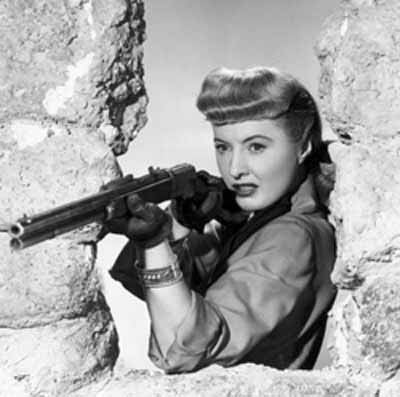
In A Personal Journey with Martin Scorsese Through American Movies, the director esteemed that of the four westerns director Anthony Mann made in 1950, only “The Furies could have been a Greek tragedy.” With grace notes of King Lear and Dostoevsky also present amid its sere landscape, go figure that when Criterion Collection adds its first ever western to their esteemed catalog, they opt for a most idiosyncratic entry. Rather than gunplay and granite-faced cowboys, The Furies instead simmers with land rights, hostile business takeovers, and the crackling Electra complex between Stanwyck and Huston. Huston plays cattle baron T.C. Jeffords, while Stanwyck plays his daughter Vance. Alternately deemed a she-fox, unbridled philly, and herd of stampeding cattle, Vance is intent on inheriting the family land, the Furies, until her father brings home a new bride and hangs her paramour. It’s then that we learn the adage: “Hell hath no fury like Barbara Stanwyck scorned.”
Tuesday, August 05, 2008

china beta


While I still haven't seen the August issue of Paste (guess getting the cover story doesn't warrant a copy?), my piece looking at the current Chinese rock scene is in it. Entitled "Daydream Nation", it touches on how NYC noise-rock inspired a new generation of Chinese rockers. While I wished there was more room to expand on such sub-topics like the woeful audio engineering/ management/ recording company infrastructure of the country, I was pretty proud of the piece (and thought the illustrations were pretty sweet). Over the next few weeks, I'll be posting several interviews stemming from the piece with folks like composer/ guitarist Elliott Sharp, club promoter Michael Pettis, Carsick Cars' guitarist Zhang Shouwang, and Public Enemy bassist Brian Hardgroove.

Thursday, July 10, 2008

the betiever

My interview with Sublime Frequencies founder (and Sun City Girl) Alan Bishop is in the new issue of The Believer, as part of their annual 2008 Music Issue. An honor for me. While you can read the full interview here, the actual issue also features a swell mix CD (featuring Animal Collective, Gang Gang Dance, Mahmoud Ahmed, Dirty Projectors, and others) as well as a centerfold map of my failed search for Thai molam music through Southeast Asia (with Bob Marley jokes aplenty). The best part of the magazine though is that the mix CD mounted in the front synchs with Irma Thomas's teeth and soft palette. Nudge the disc just so and she's either without her dentures or sporting giant horse teeth.