Thursday, April 30, 2009

betody nelson


Before I forget to mention it, I wrote an essay in the recent domestic reissue of Serge Gainsbourg's classic of 'la decadanse,' Histoire de Melody Nelson. For having spent well over a decade swooning to such orch-pop perfection, it was something else to finally learn about the creative process for the album, as well as its inspiration, not to mention finally unpacking all of the man's trenchant lyrics. Order it from Light in the Attic direct.

Monday, April 27, 2009

heep see (special disco version)


Wait for the drum break on this.


Tuesday, April 21, 2009

patti smith interview


One afternoon, my phone rang and a voice on the other side announced: "Hello, this is Patti Smith." She was calling me for a brief interview for Nylon's 10th Anniversary, to discuss her favorite concert moment from the past ten years. Coincidentally, her's hewed very close to my own, witnessing My Bloody Valentine live.

I'm not going to get all Michael Stipe here and gush about how Patti Smith influenced me or what have you, but five years ago, when I first started writing about music, I received a fan letter from Patti Smith for this review. Radio Ethiopia aside, her own work as a rock writer and poet resonates with my own, and I can't quite put into words the encouragement I felt from her. Needless to say, it was an honor to interact with her again:


Patti Smith: I had never seen My Bloody Valentine in their own time when they first entered the scene. I was living in seclusion in Michigan so I missed that phase of MBV. When I heard their records sometime later, I loved them right away, from the very first second. And then I was lucky enough to meet, work and perform with Kevin, but I still hadn’t seen MBV.

Before they went on tour, they did a series of performances at the Roundhouse in London. I thought that these performances were the greatest things I had ever seen. The reason was because...MBV is such a beautiful projection of Kevin, who is both aware of his worth yet completely humble. And MBV, of course I listened to it with earplugs, but with earplugs it was beautifully assaultive that MBV demands sonically for you to surrender, but the universe in which you are surrendering to is benevolent, because it is not egotistical. There is no egotistical 'artist' in terms of frontal attack. It’s a sonic scape that if you find a way to surrender to it, you enter into a universe which is pure and intelligent. Of course, I would not recommend it without earplugs. Mother. Also because it’s so spiritually loud. I didn’t feel like I was compromising or losing anything because of the intensity of the experience was quite engulfing.

It was interesting for me. As a performer I find it difficult to sit still through other peoples' performances. I'm restless and agitated. It makes me want to work. It's not an egotistical thing, it just fills me with adrenaline and energy that makes me want to work. That’s what I loved about seeing them. I had no desires, to perform, work, anything, but be part of this organism.

It was a total surrender?

Yes. And surrender with return. By the end, I found that a beautiful thing happens when there is a direct communication between one and the experience, at the end, just as any kid or anyone there, you almost involuntarily lift both your hands above your head with your hands out and just receiving. Like a child, lifting up their hands to the sun. It's not a military thing, saluting Hitler, it's just pure. You're just open. You just raise your arms and raise your hands to both in affirmation: "Yes I am here!" and to receive. And it's all abstract, but I found the whole experience very beautiful. I didn't drink, I wasn't stoned, it was it's own drug. That is the ultimate experience to me, to feel as if you’ve had a blessed drug experience without ingesting anything.

I was lucky enough to see them upstate. I stood with my hands up the last twenty minutes or so.

Yeah! You do. It's not a thing where you feel dopey afterwords or feel self-conscious. It's a release. You don't feel any ego. The world of MBV is completely abstract, it's an organism. It's not some club with rules, it's just all feeling. I was right there with you and I was there, too. Especially for me as a performer, I have control over my own situation, I have a lot of control as a human being, I'm fairly in control and disciplined. To be able to submit to something so completely is rare for me. A very beautiful experience. It made me really happy, like a child.

I was very ecstatic.


It's really…I love this. It's not like a thing… it has nothing to do with peer pressure. The only question is whether one should wear earplugs. Kevin is well-aware that this is an assault, a sonic assault. It is not with malice, it just is any more than if you stand in the sun and get burnt. The sun isn't out to burn you, but it is strong.

To not be like Icarus.


Exactly. We all want to survive this experience.

To have rapture and come back from it.

Like John Coltrane. He would do a saxophone solo for 14 minutes, go out and talk to God, go through the stratosphere, but he always came home to us, to the people, to his responsibility. That's part of an artist's responsibility and a part of a human being’s responsibility unless you don't want to live anymore. If you want to be an earthling, you have to come back. Like Ismael in Moby Dick, you have to come back to tell the story.

It's really great to talk to you and have you put in words how I felt about the show.

I know Kevin quite well. And I think Kevin is just one of the most beautiful people I ever met. He's just on a…he is as his music. He is uncompromising yet benevolent. He's a beautiful person and experiencing his vision and his band's execution of that vision was one of them...you asked for my experience. The only thing that could compare to it was Tristan und Isolde at La Scala.

I total appreciate it. (tell her about writing me a fan letter)

Thanks for writing about Patty Waters. I don’t write that many messages, but just to show you…in 1970, I read a beautiful piece on a capella music in an anthology about rock'n'roll and I thought this piece was so beautiful that I found the number for the writer of that piece and called him up to thank him. And that writer was Lenny Kaye. You know, he became one of my best friends and we composed most of the songs on Horses. When I'm moved to thank somebody, it's because it really touches me. I was quite touched by your piece.

Thanks. It means the world to me. I knew you were a critic and poet as well, and it was really profound to get a response like that from you.

It was profound for me to see someone acknowledge Patty Waters. It wasn’t just for Patty Waters, I have some kin somewhere. You’re the only other person I’ve seen write about her. There we are, two MBV nerds, raising our hands to Kevin and Patty Waters.

To Kevin and Patty Waters then.

Tuesday, April 14, 2009

beta gets rabid (re-run)


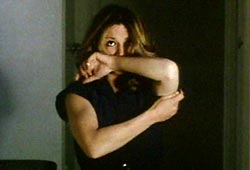
The late Marilyn Chambers, demurely covering the dog dick in her armpit anus.

In remembrance of the passing of Ms. Chambers on Sunday, I dug up this old post I had written over at Imbidimts (my old blog) over three years ago.

I watched Videodrome a few months back, but it's taken forever to track down other Cronenberg movies (and of course, since I'm a good decade behind pop culture, I still haven't seen History of Violence either, which I thought for the longest time was an adaptation of this), and it was not until this week that I finally tracked down Rabid.

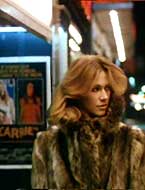
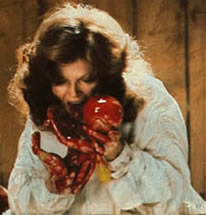
Rabid is Cronenberg's 1976 horror flick starring Marilyn Chambers as Rose, the motorcycle mama with an emergency experimental skin graft surgery that gives her a fresh flesh wound in her armpit, a moist red puncture that opens and puckers up (remind you of anything?) replete with an odd needle-tipped dripping wet red protuberance that slides out of it (sorta like a dog's hard-on), sucking at the new blood of her victims. Of course, the film meditates on a constant Cronenberg theme of technology meeting the ancient human flesh and what happens when the two mutually mutate.

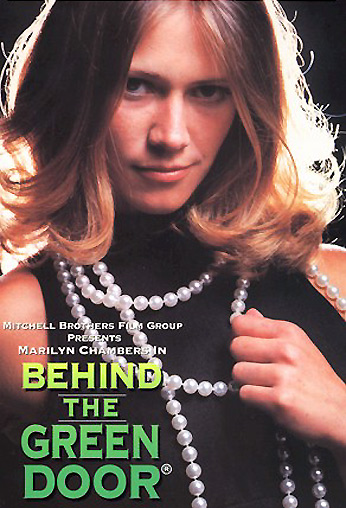
Coming out from behind the green door to again try her hand beyond the world of one-handed flicks where she was its queen, it wasn't too long before Chambers went back to porn. Her gig as an Ivory Soap 'pure' poster girl are notorious now, and apparently all of her movies feature a brief instance where she happens upon a box of the stuff, though I can't be certain if there's such product placement is on set here. There is however an allusion to the actress originally up for the role of Rose, Sissy Spacek.

One wonders how such a casting would have completely altered the movie's trajectory. Rabid would simply be a movie with green foam capsules jizzing out of the mouths of the infected were it not for Chambers' porn star fuckability that sizzles every frame of the flick. Alternately a seductress and an innocent who feigns she doesn't understand her newfound vampirism, she struts through Montreal in her fur and zip-up boots, cruising the malls, park benches, apartment halls, and the darkened porno theatres for that most odd coupling she performs on her johns. We wait and watch, mesmerized, for the next appearance of that needle-dick to pop out of her armpit anus.

Such a mutation reflects that other groundbreaking porno, Deep Throat, where Linda Lovelace has a similar sexual mutation (the clit deep down her throat) that can only be satiated by subversive means. Note there is never physical penetration in either of these movies, suggesting a new way of stimulating sexual pleasure and release. Body consciousness, questioning the sensual stimulants, things that happen inside your body, both mentally, chemically, and physically, that's what Cronenberg cooks up. His horror is never a monster movie, per se, save that your own physical body is the monster. In an interview extra on Videodrome, he says that the psychological possibility of the body to become monstrous, that is the new horror.


Cronenberg has a way of extinguishing my sexual desires though, or at least reveling in the hideousness of the human body, even if it is also simultaneously worshipping the new flesh. Which I guess brings me to the events of a past night, one wasted Tuesday night in Brooklyn, slumped over somewhere feeling the effects of the 'combo platter,' so to speak, sipping at a whisky and going through my smokes so as to dull the quivering edge just a bit.

In walks three girls, dolled up and in denim hip-huggers, tight baby tees. My drinking buddy starts up a conversation with them, nevermind that his girlfriend is waiting for him uptown, and we come to find out that the girls all work at the Coyote Ugly. Guess the leather bras have be unlatched for more acceptable tops, but they are busting out at the seams still. The girl closest to me has razor slits all along the outer seam of her skin-tight jeans, thigh flesh like shut eyes every inch or so up her leg.

By this point, I cannot recollect how I wind up in a cab with all three girls while my friend stays behind at the bar, since doing shots and more drugs with three party girls is way more his idea of a fun weeknight than mine, but I am well on my way to their apartment, for God only knows what sort of encounter. My heart races, and I go to the bathroom for that last lick of a freeze, to re-instill some semblance of chemical order to my head. When I come out, the girls are all gathered around the TV, and we're soon watching The Brood. Any sort of nervous sexual tension is immediately replaced with straight nervous system tension as the movie goes on, and the thought of even touching one of the girls appalls me by movie's end.

About the only thing I can recollect about the end of that night comes at the movie's climax, when the husband pulls back his ex-wife's long skirt to reveal the horrific, palpitating alien queen formation that makes up her vagina and lower half. "Every man is afraid that this is what happens to their ex-girlfriends," I say. Needless to say, I am relieved to go home by myself.

Monday, April 13, 2009

andy coolquitt interview


In the new issue of Tokion, I conducted an interview with Texas/ New York artist Andy Coolquitt. For those with elephant memories, he was profiled in the Sunday Times Magazine last year for his 'art house' in East Austin, though my piece focused more on his recent work with light and his forays into abandoned 'crack houses.'

Was the house in E. Austin your first convergence of art and abode?


Andy Coolquitt: No. The installations were tending towards interior architecture for a couple of years before.

When you were a kid, did you behave similarly with your room? Or was there anything you saw that made you snap to the concept?

No, it was a culmination of growing up in a series of unimaginative architecture: the houses, the church, the mall, were all designed from the same sterile worldview that most professionals had at the time. To add to that, my family although very kind people, had no education/exposure to cultural life. I grew up in a working class, Baptist, mostly white suburb of Dallas. Which I still consider as my handicap! My parents were just simply not interested in visual culture.

Lisa (Cooley, gallery owner who represents Coolquitt) talked about the idea of friends, a community, and most of the NYT photos arrange themselves as so. Which came first?

The house was initially designed for multi-use, I had the idea of building the kitchen in a separate structure in the middle of the property, from the beginning. I didn't know exactly how it would develop but the idea of creating an alternative to institutional community was key: the place or the need for a place?


Lisa also talked about the notion of 'crack houses' and I'm hoping you will say a bit about it. Is it the energy of the places, the way refuse is made to serve a purpose again, the desperation of living and consumption, etc.?

I'm not interested in crackhouses per se, but for lack of a better term 'crack spaces.' These are spaces that are outdoors, usually in the center of most American cities, usually these sort of non-spaces, undeveloped and undevelop-able, that exist next to public architecture. in-between spaces, especially in the south where density isn't an issue, or sometimes just overgrown neglected residential lots.

I'm interested in the residue of a gathering of people the night before who came together to share the crack pipe. There is always this intensely lame attempt at creating a living room. The most common solution is a piece of cardboard placed on the ground or against a wall to create a primitive sofa. Often a log will be positioned for a bench, and sometimes it's simply the markings in the dirt left from people laying down, the shuffling of feet, or a small clearing of debris.

Almost always there are 3 or 4 and sometimes up to 20 spent crack lighters. I call them crack lighters as opposed to cigarette lighters because they are used to smoke crack: the fuel valves are always removed to allow for a larger flame, and sometimes the plastic tops are melted and warped from holding the flame too long. They are always just left there, casually placed in these living rooms adding touches of color. I read this as well, as an attempt at domestication, the idea of creating comfort through collection and object fetishization.

Texas: where are you from exactly? How deep do your family roots go there?


My parents and great-grandparents grew up in East Texas, farmers and sharecroppers. My parents were the first to move into the city (Dallas) after they graduated high school.

Thinking of 'iight' (his last gallery show in NYC) and the way you have your objects lean, emphasizing the imbalance and disorientation of the pieces, I was curious if you were familiar much with Houston's chopped and screwed music or Texas hip-hop (and its vernacular) in general? Maybe I'm just coming at it as a music person...

Yesyes! Great connection: leaning against wall, speaking the bare minimum with utmost clarity, rethinking minimalism as chopped and screwed! You are brilliant. I will investigate this.

Can you compare scavenging between NYC and Texas? Did you do much in Austin? It's such a regular activity up here, from scoring terrible paintings, or records or household objects or what have you off the street corner and putting it in your own home. I have at least three paintings this way, dishes, lamps, etc. I don't really remember it much in Texas though (save for dumpster diving behind photomats).

Yeah, scavenging is really different in the two cities. It is a constant activity in both places, but in NYC it takes less effort. With this newer body of work using painted metal pipes, NYC is def a better place for gathering. There's just so much cheap furniture that gets put out. And like you say, it is so regular.

I love it when an old man will stop what he's doing and help me strap a huge load of crap onto my bike. Every old man in Bushwick thinks he knows the perfect way to tie down scavenged furniture. I think New Yorkers love to see someone re-using their trash. I usually get approving nods and sometimes cheers when riding down the street with a full load strapped on.

Of course, in Texas it's a bit tricky, peoples' notions of private property and all. And it's much more racist. When I'm in black or Mexican neighborhoods, I'm always perceived as an outsider and these negotiations sometimes prohibit the process.

Friday, April 03, 2009

Treehouse 001


Kieran Hebden (a/k/a Four Tet) playing in the Treehouse.

First Treehouse party was a total smash. Much thanks and praise to the peeps who came out in the drizzle and danced their asses off. For those curious, the first two hours are up now (thanks to Moose at Chung King for making it happen). Alas, Four Tet's set, filled with heaps of new and unreleased bangers (including one he made with Burial that's about to drop on his own label), will not be going up. You just had to be there.

Tuesday, March 31, 2009

Treehouse 001


Announcing Treehouse, a monthly-ish party being thrown down with pals Eric and Piotr, which kicks off this Wednesday, April First (no foolin'), at this lovely neighborhood bar in Ft. Greene right next to BAM, Frank's Cocktail Lounge (660 Fulton St. @ S. Elliott Pl.). Oh, we also have a secret special guest who really is both secret and special. Admission is $5 and I commence playing Arthur Russell's "Treehouse" precisely at nine.

Thursday, March 26, 2009

boredom beta


I can't say that at this point I'll ever get around to reading David Foster Wallace's Infinite Jest. Time spent with Ulysses, Gravity's Rainbow, The Magus, 2666, and Stephen King's It was more than enough, thank you. But to read about Wallace's failed struggles with his last unfinished work, tackling "boredom," fascinates me regardless. As The New Yorker's story encapsulated this "Long Thing," left stacked in the garage while Wallace swung from the patio rafters, it was a failed attempt to capture that ennui that infuses our modern Western existence, a task once thought by Wallace that "properly handled, boredom can be an antidote to our national dependence on entertainment." The article has Wallace diving headlong into an IRS office in "flyover country," as what could be more boring than that?


And yet, he thinks that transcendence and godhead can somehow be gleaned out there: "Bliss --a-second-by-second joy and gratitude at the gift of being alive, conscious-- lies on the other side of crushing, crushing boredom. Pay close attention to the most tedious thing you can find (Tax Returns, Televised Golf) and, in waves, a boredom like you've never known will wash over you and just about kill you. Ride these out, and it's like stepping from black and white into color. Like water after days in the desert. Instant bliss in every atom."


Which is well and good in a wholly intellectual and imaginary world, but as I myself have spent time in such an environment (back when I was a claims rep for a Social Security office in middle America) it's almost unbelievable to think that a grown-up could fantasize about answers lying in some branch office. When I was in those bureaucratic purgatories though, I too became obsessed with "boredom," its pervasive, paralyzing powers and sought to somehow capture the daily routine that devoured my every waking hour and made anxious my attempts to sleep and restore my energies for the next day of it. I would attempt to dredge up some moments from that time in my life here, but my mind has completely eradicated it from recall, pulverizing any trace of knowledge about such governmental Gordian knot policy and procedure such as the LSDP and the M.DOS maze navigated for each and every claim. Knowing what little I do about his bio, I do know that Wallace never had to submit to such drone work to support a family, to pay the bills, to finance his home. And in the end, neither did I, which is why I got the FUCK out. Which is why those people are there in the first place. Even as he immersed himself in the codings of the IRS, it remained a game, not a necessity.


And yet I attempted, in my earliest story-writing efforts, to try and get that boredom down, to leave in what gets left out of fiction, to where a paragraph could deaden your senses, to where time slowed, paralyzed by the drudgery of office work. Having to mete out when you took a coffee break, or a smoke break, to try and interstice that purgatory in some small way. I used to schedule bathroom breaks strategically, hiding in the stall and writing out bits of poetry, grocery lists, to-do lists, postcards, anything to try and fight the blinding glaze of tile floors, echoing hallways, perpetually-filtered air that never escapes its climate-controlled confines, heavily-tinted windows that make even a sunny day seem overcast when glimpsed from deep inside the filing cabinet catacombs. It soon became evident that rather than attempt such an alchemical art motion, instead I had to escape that environment completely, lest I lose my grip on sanity.


At the same time I'm reading about Wallace's struggles to glean art from the quotidian, I'm also reading a study of art visionary Robert Irwin. Irwin talks about eight months he spent on the island of Ibiza, pre-foam parties, in the mid-50s, when the islands were still uninhabited:
In the everyday world, you're just plugged into all the possibilities. Every time you get bored, you plug yourself in somewhere: you call somebody up, you pick up a magazine, a book, you go to a movie, anything. And all of that becomes your identity, the way in which you're alive. You identify yourself in terms of all that. Well, what was happening to me on the way to Ibiza was that I was pulling all those plugs out, one at a time...And boredom then becomes extremely painful. You really are bored and alone and vulnerable in the sense of having no outside supports in terms of your own being. But when you get them all pulled out, a little period goes by, and then it's absolutely serene, it's terrific.


At first glance, his "absolutely serene" seemingly echoes Wallace's sentiments about "instant bliss in every atom." And yet they differ crucially. An inspiration for Irwin in the realm of painting comes from a curious place, that of an Italian painter Giorgio Morandi who ostensibly did still-lifes of glass bottles and pitchers, over and over again. "What Giorgio Morandi did there was to take the same subject to the point of total boredom, to the point where there was no way you could seriously any long be involved with them as ideas or topics. I mean, through sheer repetition he entirely drained them of that kind of meaning."

Irwin talks about boredom as a discipline in and of itself, be it sitting out on an island or else in his studio for fifteen hours a day, letting his social network and marriage dissolve as he sought out the root of his investigations by staring at a line on a canvas:
Boredom is a very good tool. Because whenever you play creative games, what you normally do is you bring to the situation all your aspirations, all your assumptions, all your ambitions --all your stuff. And then you pile it up on your painting, reading into the painting all the things you want it to be...Boredom's a great way to break that. You do the same thing over and over and over again, until you're bored stiff with it. Then all your illusions, aspirations, everything drains off. And now what you see is what you get.


Re-reading the excerpted "Wiggle Room," a slog of a short story by Wallace that accompanies the article, it feels as if everything has been drained off of it and yet the illusions remain intact. Instead we have placards of characters spouting about the history of the words " boredom" and "interesting," tracing them back to old dictionaries, things that no drone in no office would ever utter, much less bother to learn about. It feels like Wallace, locked in an office, not in Ibiza. At the end of the excerpt, the main character looks at a portrait of his little baby boy and there's no trace of feeling to be gleaned from the page. There really is nothing left. But that's not boredom, that's death.

Monday, March 23, 2009

cheap beta


Not to get all Nic Cage Knowing, but...

It started innocently enough. Because of a theatrical screening of Cheap Trick: Live at Budokan, my friend and I realized that the most deadly drinking game could be played along with this concert. Every time guitarist Rick Nielsen pops up the brim on his ball cap during the concert, you have to drink. And seeing as how he pops it thirty-plus times in an hour, the B.A.C. levels soon turn deadly.

Recounting this drinking game for an acquaintance of ours (and wondering why in the world Nielsen was such a jittery freak on-stage), he tells a story about how he was friends with Rick Nielsen's son growing up, and that Nielsen's coke habit was painfully evident even to a youngster. Upon receiving a gift of a Chicago Cubs ball cap, our friend recounts that Nielsen disappeared in the bathroom so as to go "try on the Cubs cap," returning a good ten minutes later. While none of us do blow anymore, we coined the phrase "trying on a Cubs cap" to be the new code word for doing coke.

It fell away for awhile, at least until the day the Times ran this photo of Rod Blagojevich hiding his male pattern-ness with --what else?

And still, I didn't want to see the broader implications. But a throwaway line in the recent New Yorker article on David Foster Wallace's struggle with depression and suicide gave me pause:
Wallace joined the debate and glee clubs, and smoked a lot of pot with friends. One day, though, toward the end of his sophomore year, Costello walked into their dorm room to find Wallace sitting alone, slumped over, his gray Samsonite suitcase between his legs, a Chicago Cubs cap on his head. "I have to go home," he told Costello. "Something's wrong with me."

Tuesday, March 10, 2009

heep see


Thursday, March 05, 2009

lead beta


This only applies if you are walking about New York City (foolishly believing that spring is just around the corner), but a story I wrote about Lead Belly obsessive John Reynolds (whose lifelong enamoring of the man recently resulted in Steidl's massive tome Lead Belly: A Life in Pictures) is in The Onion this week. While the hefty book is a tactile delight, another sweet aspect of doing this interview is that Reynolds graced me with a Danish Souper Bag, which is ideal for toting non-Lead Belly records around town.

Wednesday, March 04, 2009

BVNG


Rounding out a trilogy (of sorts) on the disco edit scene, this week in the Voice is a feature on the RVNG Intl. imprint. And since these things pretty much disappear the moment they come out, thought I'd share one of the edits that finds its way into my "Afro" sets the most, one by Mock & Toof of Shina Williams & His African Percussionists' "Agboju Logun," off of that loooong OOP Nigeria comp on Strut. Dig it:

Mock & Toof: Digit 3

Tuesday, March 03, 2009

fever beta


Within hours of listening to the delirium-inducing Fever Ray album, I came down with chills, aches, and a 102° temperature. Coincidence?

(Well, I guess it could be, as the Fever Ray cdr that my friend handed to me also had this Conny Plank-produced Whodini song called "Nasty Lady" tacked on at the end. And that song is the sickness, too.)

Thursday, February 26, 2009

DJeta


For those of you who have never seen me in action, it's sorta like this, though I rock tighty-whities.

Last week's set with Dave was pretty telepathic. Hadn't really let on to him that after ingesting a few of "Willie's brownies" I had decided that everything would sound groovier at the wrong speed, slooowing down everything from this Studio remix by Todd Terje as well as Con-Funk-Shun's ludicrous "Ms. Got the Body." Dave seemingly anticipated this with this Tom Tom Club b-side "Spooks" and the weirdest Whodini song I never heard. And even when I tried sneaking in a mini hip-hop curveball by him (Young Jeezy, Fat Boys, Method 'Tical' Man) he just dropped more Mobb Deep.

Anyhow, late notice, but I'm playing records with my friend Gerald at Stanton Public (17 Stanton @ Chrystie) tonight, downing cask beers no doubt. I won't be cutting up the coda of "Hey Jude," but as I can sneak in a few CDs, I will no doubt drop this super-long track.

Tuesday, February 17, 2009

Lofta


Scant months before I relocated to New York City (back in spring of 2001), a thread on disco music (no doubt from the Chugchanga listserve) put names like Arthur Russell, David Mancuso, and "Soul Makossa" into my ear. Like most people of my generation (particularly in middle America), disco was a particular blind spot, filled solely with Saturday Night Fever, "Play That Funky Music White Boy" and The Village People. While I was never as knee jerk as this particular douchebag, disco music meant little to me.

I'm still not sure what prompted me to special order David Mancuso Presents The Loft 2CD set from the confines of Dallas's suburban hell, but its pleasures were immediate to my ears (even if it took a second before "Is it all over my face?" X-rated rhetorical question answered itself). And while I continued to remain slightly oblivious to disco's charms my first years in the city (at least until the DFA righted me and most of white America) the thought that "The Loft" remained a very real and extant celebration stayed with me even as I trolled through stilted indie-rock shows and free jazz mausoleums those first years here.

Before his academic prose wholly dried out disco's forbidden fruit pleasures for me (to where I never got through the book), Tim Lawrence's Love Saves the Day connected Mancuso's social experiments and dance parties back to those of Dr. Leary and Dr. Alpert, which truly expanded my mind. In retrospect, I now realize that acid-gobbling goes far better with moving to positive body-moving music rather than standing still in sweaty punk rock venues, but I have no regrets about my roots in Texas punk rock.

For the past few years, I have seemingly just missed Loft parties, or else asked Loft members scant days after the fact, always just a step behind. Anyhow, after two years of interviewing NYC DJs, and even receiving an email from the man himself back before I left for Thailand, I finally FINALLY finally had the chance to experience David Mancuso's Loft party for myself. And it was everything I could've imagined yet wholly beyond my previously held notions of what dance, disco, church, celebration, love, and baby powder meant.

The member who invited me said he'd kill me if I blogged about the experience, so let me just say it was a dream come true to dance all night in the light of such a miracle. Love saves the day, tis true.

Friday, February 13, 2009

vladislav delay/ luomo/ sasu ripatti interview


Starting in late 2007, I began a correspondence with Sasu Ripatti (a/k/a Vladislav Delay, a/k/a Luomo, a/k/a Uusitalo, a/k/a________) that stretched well into 2008. And yet it was impossible to find an outlet for this interview. Despite creating microhouse's truly totemic Vocalcity, not to mention the drug-dubbiest electronic albums of the late 20th century/ 21st century like Entain, Multila, and Anima, he was deemed too obscure by almost every single editor I encountered. Thankfully, the release last year of Luomo album Convivial allowed me to place a feature over at XLR8R, though it is only just hitting stands now. Here are a few extended excerpts from our conversation:

i rarely if ever revisit my old work; for me it's obsolete in some or even many ways after it's been made. usually the life-span of a project for me is the initial feeling or an idea to do something, and then the most enjoyable period of envisioning it and living with the pre-production phase where you dream about it and come together with it and make friends, and then of course the hard work itself, to turn all those feelings and plans into something concrete and struggling with all the practical aspects until the end where you are holding something in your hands and either agreeing with it or not. but then it's more or less over. same with concerts and almost anything else i have been involved with.

the projects become somewhat public domain after i have finished with them and they begin feel less personal and i loose interest in them through that. and of course there's the practical aspect of really spending quite a bit of time in the studio or elsewhere dealing with all the new music i'm making that i really don't long to listen more of my stuff if i have some free time to choose to listen anything i fancy.

i guess there are more reasons that i don't like to revisit the older works, one at least for sure being the over-critical myself that doesn't really allow me to enjoy what i have done but rather pays attention to all the things that i would do now differently, and all that picking up on unnecessary things but i guess that's very common among the producer/artist/etc types.

i know i should maybe do more critical analysis of what i have done, after longer periods of time have passed since the works were made but that's something i have so far avoided doing, and i let the memory golden the facts in time and make my peace with everything i have done in that way.

i think the only way i really spend any time with my older works is when i perform concerts and even then i most often choose to play either the very recent material or unreleased new stuff to see how i might react on it in front of public which is always the most real test listening test you or at least i can do.

> What kind of stuff affected you back during that time?

back when i made Multila? it was a lot of a drugs, i must admit. i was strongly inspired by and into the whole mind- and reality-altering thing, escaping the "now" and living somewhere else. there were quite long periods back then when i was really quite out of it, but fortunately more often than not spending time sketching out some musical ideas.

i'm glad there always was the strong drive to make and be with music, otherwise who knows what might have happened.
looking back in retrospect many things seem naive now, but at the same time i like the fact that back then i was really imagining things more than being ultra realistic that i am nowadays after going through more stuff, both good and bad.

i was really thinking differently about my music back then, not knowing what's out there and thinking the sky's the limit with what i can do with music and that it belongs to everywhere, not being the underground stuff it ended up being.

when i made Multila i thought it's very cutting-edge modern music, especially the more ambient pieces, and not just being electronic or post-techno stuff, and that it should be played at fashion shows or advertisements or movies of the most cool kind. it was a shock to really realize where i did end up with my music when i begun traveling to concerts; really i couldn't believe it was only barely happening and in the very leftfield of the leftfield and nobody was paying musical attention to it besides some chin-stroking guys.

but i think exactly that unawareness was a blessing back then, so i could just come up with anything i imagined, also through being out of it with drugs, i just wasn't thinking and analyzing things like i do nowadays but just going for it. but that's only one side of it. the other side drove me to quite a bit of trouble, health wise and otherwise and there was no light in the end of the tunnel and i'm glad i could become little bit more connected to real world eventually.

***

>i read recently you did a live soundtrack for Aki Kaurismäki's I Hired a Contract Killer. and was wondering about your approach to a movie like that, less-dependant upon dialogue and more for scene-setting. what drew you to that film? even when I listen to something like Four Quarters (to say nothing of sampling Hurlyburly for Anima), it has a cinematic sense of rhythm to it, many different elements moving at once, not cohesive in one sense, yet all in the same scene.

cinema is for me more entertainment than anything else. so i'm watching all kinds of stuff, without much filtering. i'm happy to be amateur in film world. but more and more i find myself referring to some movie, how they made it technically or storyline-wise etc, and thinking how could i turn that same feeling onto music i make.

that's what i like in music, that it lives like a life or movie or anything, that it's not just a metronome steady and artificial in that way. faltering, collapse, disintegration, that's what life is sometimes, right? so music should be as well. i don't want nor do i try to separate my music from my life.

for long time i avoided playing with any visuals, partly at least because i wanted to try making the music part as visual as possible and then the thought of having visuals there didn't really add to it but distract. playing to a movie opened some doors for me though, namely it gave me a freedom not having to fill in everything all the time. which is what i could of course do without movie as well but having the visual stuff going on there i felt more secure to let go off the music for quite long periods and play very sparsely which i enjoyed a lot, and for sure i will be doing more of that now also when playing alone without any visuals. i wonder how that will work though, to be seen.

what drew me to the film? i guess at least partly home sickness. i miss Finland sometimes a lot and Kaurismäki's movies sure me quite well. even movies that are not taking place in Finland (like "I Hired...") they have that something Finnish in there that i like and miss. above all, i think his movies are great no matter what, i have always liked them. i will be playing more to his movies in the future, really looking forward to that.

***

there was absolutely no clubbing lifestyle, but rather a pure drug lifestyle. i didn't really read any drug literature either, i just experimented with drugs with some friends of mine. you know, staying at home with dope. looking back i was really immersed with all that stuff for quite long time. i even named my label narcotic back then, and even today completely sober person i chose to keep the name when i re-launched the label because the whole drug thing was so much of an influence to me, and still is.

it definitely gave me some inspiration and ideas i would not have gotten otherwise, but then again i don't think they were anything essential necessarily. but i do think the overall vibe i have is still drugged out, not that i'm still spaced out but that i still think it's a great feeling to be out of your body and feel otherwise, and i do still draw from that feeling when i make music. nowadays i try different techniques for all that, like yoga or whatever meditation or music no matter how esoteric it sounds but it works and doesn't fuck up my body but the opposite. i think back then though i was too fucked up to make any concrete decisions anymore, so it did more harm than anything else. i also got into health problems and had unnecessary issues with criminals and cops etc. so all that just almost completely destroyed my music.

Saturday, February 07, 2009

heep see


Tuesday, February 03, 2009

DJeta


Was so busy crating every last $1 record I had accrued over the last few months (Foxy! Universal Robot Band! Carrie Lucas! BB and Q Band! Mtume!) that I forgot to say anything about it over here. Oopsy.

What you missed: a fine outing by myself and pal Eric; being surrounded by pals; a R.I.P. set featuring Delaney Bramlett, The Cramps, and John Martyn (this edit of a live track of his getting at least four people asking if it was the raddest U2 song ever); a white fur clad girl who randomly fed me beef jerky like communion; this sweet transition from New Order "The Beach" into Donna Summer "Our Love" into Lime's "On the Grid" (though we dropped the dub); and then us dancing to this monster boogie jam. Weeee...

Saturday, January 31, 2009

Simone White interview


This was the commencement of an interview with singer Simone White for an article I wrote about Honest Jon's Chop-Up Revue last year, yet I wound up not using her quotes. What was a pleasant surprise about the night was how Ms. White commanded the crowd's attention amid that roster of folks: Candi Staton, Tony Allen, Hypnotic Brass Ensemble with only her hushed songs. I wished that we could've delved a bit deeper in our correspondence, but very excited to see her tonight and see how she does alone in the spotlight.

I'm curious as to how your music came to the attention of Honest Jon's in the first place. Were you familiar with the label beforehand?

I was living in New York and I'd booked a tour on the West coast. I was doing long drives and I was listening to Bonnie Prince Billy's Master and Everyone on repeat. I love this record: it's close and tender and Will Oldham's voice is so pure. I kept saying to people, “I want to make a record like this.”

I met a woman in LA whose boyfriend was from Nashville and knew Marky Nevers, the producer. I went there three times and made a record, first spare and simple, then adding more instrumentation. Finally it was done and I knew I wanted a record label to put it out, as I'd self-released my first record and knew the business side of it, everything that is involved. I was no good at it and needed help.

Marky sent it to Mark Ainley from Honest Jon’s and he liked it and we went back to Nashville and we added some trombones and strings and recorded a few more songs. I wasn't familiar with the label but Marky Nevers had recorded two others that they had signed, Candi Staton and Lone Official. I liked Mark Ainley right away, he's weary of all the bullshit and he's only interested in good music and being authentic (and he would totally cringe and make some typically sarcastic English remark if he heard me say that). For my first record I had used my friend's label's name, The Sincere Recording Company, so I thought it very fitting to be with Honest Jon’s.

I'm afraid I wasn't very familiar with the music on Honest Jon’s. The closest I probably got was Ali Farka TourĂ©'s collaboration with Ry Cooder (Talking Timbuktu from 1994) which I loved, and of course all the old folk music my mother sang to me when I was little. I guess my music has most in common with Candi Staton as Marky Nevers produced both our records and used a lot of the same musicians. I didn't think it was strange that Mark Ainley liked my music though. I probably thought he connected with the political songs and the folk aspect.

Speaking of Will Oldham, have you heard Lie Down in the Light, the album that Mark did last year? I seriously think it's Will's greatest record so far.

No! Is there a new one? I didn't know!

Is that your mom on the cover of the album? And is she with a pet leopard? And on the packaging, is that your grandma singing in bloomers and heels on-stage?

Yes, my mom and my grandma were performers and they had a leopard. He lived on the third floor of their house and chewed all my mom's shoes and handbags. I have a million photos of them in all these great outfits, posing with the leopard and on top of their pink Thunderbird and in parks with my grandma's series of Chihuahuas and performing on stage.

Were there always such idiosyncratic and flamboyant women in the family? The pictures really help convey this dislocated feeling I have with the album where I feel it could emanate from really any era, yet it sounds sorta outside of time as well.


There were and are strange and flamboyant women in my family. My aunt on my dad's side was writing pop songs in the fifties at age 13 and my paternal grandmother founded all-women run newspaper in Michigan in 1949.

Did you feel that coming to the guitar so late (the bio says 22) and not being around pop music when you were younger helped you in some sort of way with writing your songs? Or are you now playing catch-up with music?

That's funny you say coming to guitar late at 22. ‘Cos to me 22 doesn't sound late, as in fact I didn't start playing guitar really seriously until about 30. If I only was serious about it at 22! I think the stuff I was playing at 22 wasn't from my true nature. And if I'd stuck with it then I might have worked it out faster or maybe it would have taken me the same amount of time. Because I feel like I got closer to myself and to the music I'm making now through whatever I was doing: photography, writing, acting, and that now it's coming out in music most strongly and most pure.

I think not growing up with pop culture must have influenced me, but I can't identify what's missing. And I don't really live in pop culture now, I don't watch TV which seems to be the big connector of all people. I sit in the garden and stare at the green stuff.

Wait…when you say "playing catch up with music," do you mean playing catch up to the music that's out there or playing catch up with music that I'm playing? ‘Cos there's no way I'll ever catch up to all the music that's out there. I remember when I was a teenager having a list of cool bands written in my notebook so I could rattle them off when people asked which seemed to be the first question you asked someone in high school. If you mean playing catch up with my music, I don't think there is an age for doing anything, especially not something so primary and human as music.

Monday, January 26, 2009

BVOTR


You know it's been a sweet week when (finally) landing the cover story of the Voice doesn't even rank over at ye beta blog. Shit, at least it's better than that asinine Harkavy cover story last week with George W. Bush on the cover emblazoned with the headline: WE'LL MISS YOU. We'll miss you? What the fuck?

Anyhow, I finally wrote an essay for Pazz & Jop and --in the words of a snarky well-wisher-- was able to tap into my inner Xgau. I originally titled the piece "The Shockadelica Doctrine" but that was giving waaaay giving too much cred at their feeble attempt at Prince-dom. Did you hear that "Dancing Choose" b-side "Make Love All Night Long"? So not smoove. No wonder I saw Tunde on the G after their sold-out shows going home all by his lonesome.