Sunday, September 17, 2006

polk salad beta

Chomp-chomp.

In the days leading up to Tony Joe White's show at Joe's Pub, I had a song of his looping on the iPod inside my head. Goes "Mama Don't Let Your Cowboys Grow Up to be Babies," from his disco-untry record, The Real Thang. It soundtracked not just my anticipation at seeing the Swamp Fox far from his normal climes south of Mason-Dixon, but topped a recent immersion into country & western music (yeah, both kinds): Waylon, Tompall, Willie, Bob Wills, Hank, Lefty, Jerry Lee, Johnny Darrell, Steve Young, Mickey Newbury, Guy Clark, all pushing through my other deadlines and shoving young'uns out the way so that their three chords and the truth could ring out.

Sure, Tony's boot-scoot is both clever and biting (like the finest country cuts), but whether I'm hitting rewind or else flipping the 45 so as to get to the mono version, it starts to strike me differently. Its inverse, Waylie and Willon's "Mama Don't Let Your Babies Grow Up to Be Cowboys," is without a doubt the first song I can recall reciting, back in the days of diapers and cowboy boots, while this one went unheard. And I didn't grow up to be a cowboy; I tweren't raised on chicken-fried steak and milk gravy; I never drove a truck. If anything, I more identified with Albini's sneer: "I've never seen an Indian on a horse." And I've begun to lament that my childhood didn't involve more fishing and hunting, rituals that comprise many a boyhood in South Texas.

When I was living in Texas as a teen and hepster, I flipped past the hillbilly-hick records looking for jazz oddities, for outsider noise, for chilly Euro synth-pop, for "the other." I anticipated AMM, Arthur Doyle, Adult., and Thurston Moore noise shows pulling through town, and never got a chance to see Waylon or anyone else of that ilk. And now in New York, I look back with great fondness on country music, fully removed from the redneck contingency while also remaining blissfully removed from country's current incarnation. I seek out the green green grass of home here, comforted by the country section at Academy Records, searching for sleeves featuring white cowboy hats, denim shirts, outlaw records at triple the price they would be down south. Is it simply nostalgia, that fool's sensation that leads to $95 faux-vintage Def Leppard tees and VH1 package tours of Scandal, Styx, the New Cars? (Mind your own business when eyeing my "authentic" Willie tee.) Perhaps. In the epicenter of all things skronky and out, I couldn't give a fuck about free jazz, about obtuse noise slabs, about weirdo records now. Gee, ain't it funny?


Tony Joe White - "Mama Don't Let Your Cowboys Grow Up to be Babies"

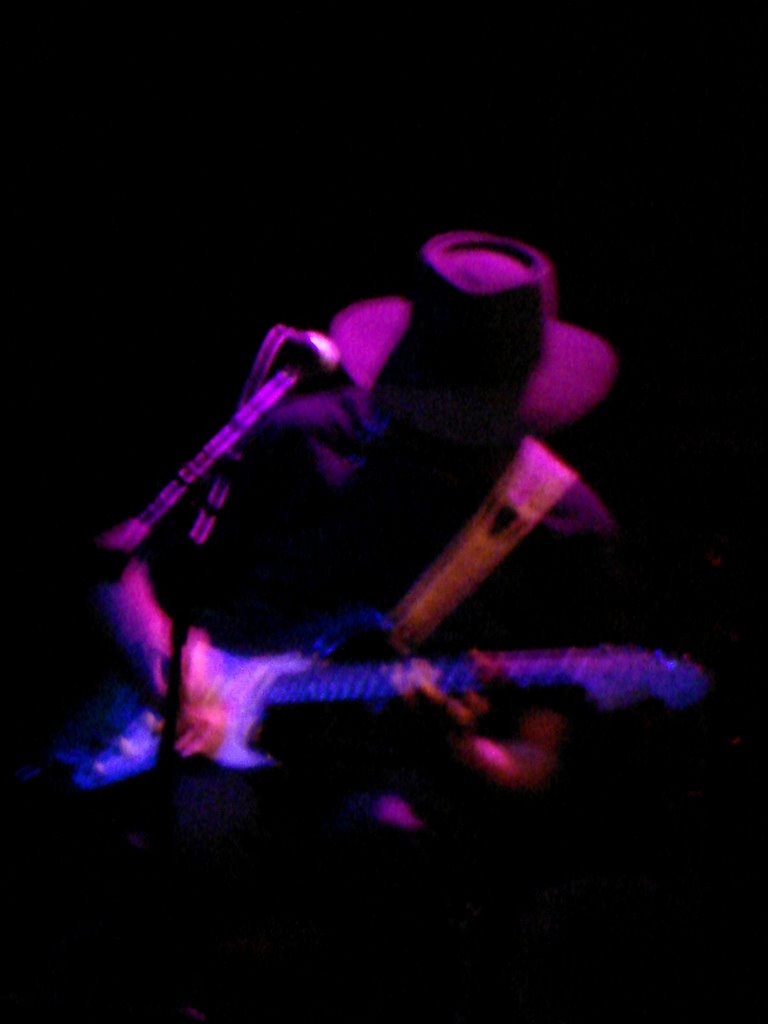
Or maybe it's just an appreciation for craft, for nailing details and human thangs rather than abstracts and the non-narrative, for witnessing elders still plying their art in a way that rings out honestly., that gives hope for my own self turning into an elder one of these years. Tony Joe stomps out in black boots, a wide-brim hat, mirror shades, sits and recreates the humidity of the south up north. While he didn't play "Mama" live, Tony Joe pulled out all of the classics: "Polk Salad Annie"; "Did Somebody Make a Fool Out of You?"; "Rainy Night in Georgia"; "Steamy Windows." He had blues about benzes and condos, rhymed "water moccasin" with "chicken," dangled garter belts over a lick copped from "La Grange" (haw haw haw), and when he slid his right foot over to that wah pedal, he unleashed the nastiest sort of swamp, whipping up a viscous, verdant fury like a mean ol' gator tail. My friend felt like he had an amoeba growing in him afterwards. Which is sorta what homesickness feels like.

Wednesday, September 13, 2006

Friday, September 01, 2006

beta luv vashti

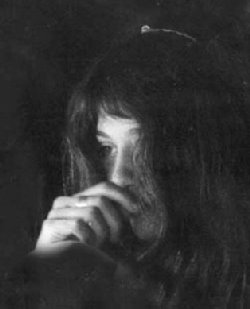
End of summer 2000, as "Pink Moon" fever sweeps across the psyches of emo kids via that VW commercial, inspiring Island to press up the Nick Drake discography once again, I'm in the record store with a friend of mine. She's buying Nick, while I peruse the stacks. I come across an odd-looking album: a woman in a baboushka and apron standing in the doorway of a house with a horse, cow, and dog painted on it. I'm not certain just what sort of name "Vashti Bunyan" is, but I see that Drake's producer Joe Boyd is on it, as is Robin Williamson from the Incredible String Band. I take it into the listening station at Waterloo Records and am floored by the hushed whisper that issues forth like some sort of secret. When I play it for my friend, she wrinkles up her nose, finding it too twee and fey. Best she stick to Nick Drake, I guess.

Overnight, Just Another Diamond Day becomes a part of my mind, to where I have to play it at all hours: in the bright black of morning light, for afternoon delight, when day is done. Vashti evokes the hills and dales she herself was travelling, suggesting immaculate open spaces as well as the intimacy and warmth of a campfire in the evening's chill. Her songs were so small and beatific, like when a ladybug alights on your hand, when a butterfly dances past.

Since that date, countless others have felt similarly about her vespers and sighs, and as I anticipate her imminent arrival in the US, here is a long interview I conducted with her via email in the months preceeding her follow-up to JADD, Lookaftering. Pitchfork turned it down at the time (too obscure and no one cares, Ryan Pitchfork said), and it's sat in the limbo of the US version of Ptolemaic Terrascope for years now as well. And so:

Could you talk a bit about your upbringing? Songs you loved when you were young...

I was brought up in central London, the youngest of three. My brother and sister were a lot older and looking back I think they were brought up 'properly,' whereas I was pretty much left to my own devices and so ran a bit wild. Post-war London was a great place to be allowed to run wild and this I did. Playing on bomb-sites, no-one really knew where I was alot of the time and I learned to get around by myself. Every so often my wild ways would come to my parents' attention and I would be brought to heel. The worst time was when I was sent away to a private girl's school in deepest countryside at the age of fourteen. I was horribly homesick for London and for freedom.

Did you grow up around much music?


I have always loved music; my father had a large collection of 78rpm classical records, his favourites being Handel's organ music and Beethoven's Pastoral Symphony and the singer Kathleen Ferrier. She was my favourite, too, along with the choirboy Ernest Lough who sang "O For The Wings Of A Dove." I played these records over and over when no one was looking and got in big trouble for scratching them and blunting the needle. Records were very fragile then. I had wanted piano lessons but the family finances were always in trouble from my father's latest invention needing patent lawyers et cetera, so I taught myself or copied friends who did get lessons.

What was pop music like around that time?

Popular music was staid and boring in Britain when I was very young, but the mid-fifties brought American music across: Elvis Presley, Buddy Holly, Ricky Nelson, Everly Brothers - I became fascinated by all of them. Their British equivalents, too: Cliff Richard, Billy Fury, Adam Faith, Johnnie Leyton. I saw the film Expresso Bongo the night before being sent away to school and I think that seeded my wanting to be a pop-singer. It also brought the beginnings of young people taking on the music business for themselves in Britain - leading to the rise of the Beatles and the Rolling Stones in the early sixties. Which was good, as it was a quiet, boring time at the start of the sixties: Peter, Paul and Mary, Kingston Trio...even Elvis and Cliff were going soft.

I was brought up in London and so saw it in all its pre-sixties black and white post-war austerity and terrible disapproval of young people going against their 'elders and betters.' I also witnessed the way those young people took over for themselves. In the fifties, there were adults and there were children – nothing in between. Especially for girls. They all dressed in their mothers' style as soon as they were old enough. Being a teenager in the early sixties was like pioneering, all uncharted, exciting. A huge upheaval. Now the sixties are seen mostly for their psychedelic years but what took place before that – brave rebellion in the face of severe authoritarianism at the start of the decade – that was what paved the way.

Was this because of the Beatles and Stones and seeing that young people could be themselves and act in a manner different from their parents?


Well...I remember the Beatles first appearing, but I wasn't that interested by them. It kind of felt like more of the same, only slightly better. But then I saw the Stones at a college dance and fell for Mick Jagger immediately. He was so scornful and aloof and the music was so raw and different and wild.

You saw the Stones when you were at Ruskin?

No, this wasn't at Ruskin College. The dance I saw the Stones at was probably at Balliol College, and I think it was 1963.

And this was when you started playing?

Yes, I was 18.

What were some of the first songs you learned?

Buddy Holly's "Every Day" and Bobby Vee's "Sealed With A Kiss."

Was this around the same time that you met Jennifer Lewis and Angela Strange?

Angela Strange was my godfather's daughter and we grew up together. Jenny Lewis and I met on the steps of the Ruskin School of Drawing on our first day back in 1962 and have remained friends ever since. She taught me to play guitar and we wrote songs deep into the night about how hard love is. I have a recording of the second song I ever wrote and it is painful to listen to...like finding your teenage poetry in an old box. Paul Lambden at Spinney is putting together a collection of all the first singles and demos from way before Just Another Diamond Day. I have to think whether or not I dare put that 18-year-old's one on it or not.

And you began to perform out as a trio with Jenny and Angela?

Yes, briefly, as 'The Three Of Us.' We did a few college dances and a charity ball at the Grosvenor House Hotel in London dressed in matching Mary Quant – singing Everly Brothers and Buddy Holly.

Was Ruskin progressive at all in terms of study or curriculum?

No, Ruskin was a very traditional establishment. They taught drawing and life painting, still-life and composition – in a way it had been taught for generations. I was bored there. Playing guitar with Jenny was far more interesting. Staying in bed also. After two years the school despaired of me (for singing not painting) and I was asked to leave. They stayed on – so our musical paths went different ways. Both Jenny and Angela still live in Oxford.

Is it true that from your college days you had some sort of connection with Monty Python people?


Yes, Michael Palin and Terry Jones were friends of Jenny and mine. They wrote and performed sketches while still students. They were always brilliant. Jenny still sees them from time to time.

What was the impact of other singers around that time on you? I'm thinking
specifically of people like Marianne Faithfull, Jackie DeShannon, but perhaps someone more folk-based, like Shirley Collins...


When I first started writing songs, I was only aware of Carole King – whose songs I loved. I became aware of Marianne Faithfull when I came home from New York in 1964 after discovering Bob Dylan and making up my mind that I really wanted to be a pop singer and record my own songs. She had become very successful while I was away and I was a bit put out to see that she'd come close to doing what I wanted to do, even though she was not a songwriter.

I was never really aware of Shirley Collins at that time or Sandy Denny. I know their music now of course and admire them both – especially Sandy Denny. I think in general I never compared myself to anyone else if I could help it, nor did I follow or try to imitate any kind of style, and so it was – and still is – strange to be categorized with people I feel no musical affinity with at all.

At what point did you start performing on your own?

Right after I was asked to leave Ruskin. Jennifer and Angela became a duo in Oxford while I headed off on my own in London. I sang in a few dingy night-clubs where no-one listened and they must have wondered what I was doing there in my scruffy black clothes, just me and a guitar and some sad little love songs. I never sang in folk-clubs – never occurred to me – I was not a folksinger.

Was that how you met up with Andrew Loog Oldham?

Not in a club. I sang reluctantly at a party given by a friend of my mother's. She was an actress and there were many show-business people there – amongst them a theatrical agent called Monte Mackay. She knew Andrew Oldham and she must have reckoned he was looking for another girl singer since Marianne Faithfull had just left his management. I was summoned to her dark plush office and there was Andrew, looking fabulously beautiful and completely other-worldly – another world I wanted to be in. But I was there in my usual scruffy clothes and mournful expression probably and had no thought that he would be remotely interested. I sang my songs and was sent away.

When Monte told me Andrew wanted to have me record a Stones song I just didn't know what to do. I'd wanted to record my own songs and so sulked for a bit. Then he said I could put one of mine on the B side – and a second single could be one of mine. My father told me I should compromise – so I did. I completely loved the times recording with Andrew, and working out a song of mine with David Whitaker. So brilliant for me as I know nothing of music theory – and so to have real musicians playing my song felt fantastic.

Did you play many shows by yourself?

While I was with Andrew's management I was not allowed to go on the road in case I got into drugs. Seems funny from here, but they were very protective of me for some reason. When I left Andrew to strike out on my own again, I did some live shows but not many. I always preferred writing and recording to performing.

Was this nearing the time you left London?

Yes, around 1968.

What was drawing you to leave?

I remember feeling desolate – I had not made my musical career work, there was even more family pressure to conform (get a job or get married) and the world outside was making less and less sense. Consumerism was taking a hold. The Vietnam War was craziness and too painful to watch, but I could not really identify my feelings of hopelessness. I wanted to somehow get to the realities of life and try to live differently than the way I had been brought up, which was this vacillation between being protected and disapproved of in equal measure. I also wanted to get as far away from London as I could, for it was filled with musical failure for me.

Can you tell me how you met Donovan?

He was an old school friend of my boyfriend, Robert, at the Art College. I met him a few times when visiting these friends of Robert's. He was around when Robert and I were trying to get the money together to buy the horse and wagon we had found, and he lent us what we needed, and we stayed at his house just north of London whilst we prepared the old wagon for the journey.

Tell me more about this proposed artist's commune he was trying to settle. Why did it disperse?


Robert and I were not really in on the plans, we just thought it would be a good idea to head towards Donovan's dream of an idea – a loose community of like-minded people who would probably be painters, writers, musicians. He said it would be a West Coast Renaissance. Donovan and his friends went up in a Land Rover in the summer of '68 just after Robert and I set off with the wagon. They spent two summers and a winter digging the ground and experimenting with self-sufficiency while we spent the same time traveling north. By the time we got there Donovan was no longer living there (though he just happened to be there when we arrived) and most of the others had decided to return to the city. Two resolute friends are still there though – they lived the life, brought up the children and made the dream a reality.

Was the horse and carriage part of a complete renunciation of modern life?

Yes in a way – although it was all we could afford to do at the time. We had very little money between us and nowhere to live, so it seemed to be a good idea. Once the thought came – we found the horse and the wagon quite miraculously. I didn't really have much idea of renouncing anything – I had no great political ideals or philosophy to follow. I was just trying to find a way to live that felt all right.

It must have been a rough change. Did you quickly acclimate to life on the wagon?

Well, we had been living under a piece of canvas in a wood behind Robert's art school while he prepared his degree show. That was the rough change – from my parents' house in London. Having the wagon was a step up as it meant we then didn't have to sleep on the cold ground any longer. Being up in the air was good. The wagon was too small for a stove so we got cold and soaking wet many nights. I cooked on an open fire on the ground and we lived on very little, earning money by digging gardens and painting farmyards and collecting scrap metal to sell. It was not comfortable and sometimes I felt like going home, but then these responsibilities came forth: who then would look after the horse? who would look after the dog? who would carry on the dream?

What made it worthwhile for you?

When the sun came out, when we made good progress, then it was the best feeling in the world. We met some wonderful people and had adventures that if I were to write them down people would think I'd made them up. Other times when it was cold and I missed my family – not so good.

How did this lifestyle begin to affect your songs? Was there a metamorphosis that was made evident in your mind with these new songs?

My first songs had been about how hard love is and how it can go so wrong. Sad teenage songs. Andrew Oldham put orchestral backings to some of them. I like these versions. It has been said that Andrew took me down a road I didn't want to go down, that I was a quiet folk-singer and that he drowned my little songs with his own take on them. This is not true!! I wanted the orchestras and the big arrangements, I loved that treatment of the quiet songs, but when it didn't work out for me I went back to singing on my own with just a few instruments. But I was never a folk-singer.

When I first met Robert, he persuaded me that my songs were just miserable and that I should look outside myself. And so I did, and I started writing songs about what I saw and telling the story of our road life. I didn't think the songs would ever be recorded as I had left the music industry behind me for good I thought - so they were just a kind of diary. Joe Boyd changed all that but even so I left it all behind again, really for good this time. Till now, at least.

What was recording
Just Another Diamond Day like?

It sped by in a blur and I don't think either Joe Boyd or myself can remember much about it. I just sang the songs as I always sang them. Only three or four days actual recording – over a few weeks. I do remember that he wouldn't let me use any overdubs or trickery of any kind which annoyed me a bit. I wasn't the same kind of purist as he was. I would have liked to experiment more. He was probably right.

Did it feel weird to come back into the city after so much time in the countryside?

Yes – it was like coming home after a self-imposed exile. I loved living in the country – it had been my childhood dream and I spent 25 years there – but I grew up in the centre of London and even removed from it now, I still feel like that is where my centre is.

Were you more certain of your songs this time around? Or were you still worried about musical failure?

I hadn't intended to record them when I wrote them – I would just play my guitar out of habit whilst traveling and the songs just came to me on the wagon. I wasn't worried about whether they would fail or not as I was quite sure no one would ever hear them except Robert and myself, and the horse, Bess. Then when I was recording them, I still didn't think many people would be interested enough to hear them.

Can you tell me anything about playing with Robin Williamson from the Incredible String Band or Dave Swarbrick or Simon Nicol from Fairport Convention?

Robin's playing on "Rosehip November" was like a small miracle to me. We did it in just a few takes, it wasn't rehearsed and so I can't imagine ever trying to play it live. It had such lightness of touch from everyone.

Playing with Dave and Simon was a very good experience for me. I had never played with anyone like that before. It was great to hear them pick up my songs so quickly and run with them. I was a bit over-awed really and was sure they'd think the songs too small and unworldly. They were kind though.

What did you think of JADD when you had finished it?

I didn't hear it for some months during which time I was in the Hebrides or in London having a baby and Joe was in the US. He took the tape over there for mixing so I had no input from then on, apart from choosing the running order.

When I heard it again, I was worried about the handmade sound of it, all the wrong notes that I would have taken out but that Joe left in, and I thought it had missed the small window of opportunity that it would've had when the songs were first written. By 1970, the gentle dream had come and gone.

What was the critical response to it at the time?

I only read one review and it was enough to send me back to the hills for the next twenty-five years. Recently, a friend unearthed some other reviews from the time and they were much kinder. Maybe if I'd seen them then I wouldn't have given up so readily, but I completely closed it all down, and didn't play for ages.

And what happened afterwards? Did you and Robert settle down at some point?

I don't know that we settled down exactly. Our lives just went from day to day and we never expected to stay together for the twenty-two years that we did. We lived in various rented farmhouses in Ireland and then back in Scotland and eventually after fifteen years we bought a ruined farm north of Glasgow. We spent the next few years building it back up with the help of many different people – some who came by for a few days and stayed for years, others who visited from time to time. Robert and I separated in 1991 and we both now live in cities, but remain friends. We went through a lot together and nothing changes that.

We had three children: Leif (who lives in Los Angeles) and Whyn (she now lives in the row of cottages where I lived with the Incredible String Band when Leif was a baby) and then Benjamin who arrived when I was 41. He's on a basketball scholarship in the US – a very different child to Leif and Whyn. Another generation – but they're all close.

Did you continue to play and write?

The way we lived meant that there were many people passing through, some of them musicians, including the Incredible String Band, but I could never admit to my own musical past and so I would not join in with any music that was being played. My lovely old Martin guitar just gathered dust on the wall.

So some thirty years on, are you surprised at the amount of love and respect
Just Another Diamond Day has garnered over the years?

Very surprised. When I haven't thought about it for a while and then remember its existence, my heart leaps – it's like I'm living in a different life, another world. As if the album has had a life of its own quite separate from me – that I abandoned it and it has now found its way back to me and asked, "Oi! What about me, then?"

What is it like to meet fans such as Devendra Banhart, Kieran Hebden, the Animal Collective, and to record with this new generation?


Devendra, Kieran, Adem, all the Animal Collective and Dave at FatCat and Max Richter...and the many others I've met since coming back to music – they are who I didn't have around me back then. They are who I longed for back then.

Is it good to be back?

It's like being given another go at it when I really don't deserve it – the way I ran off and denied JADD for so many years. I am overwhelmed. But yes, it's good to be back, more than I can ever say.
Thursday, August 31, 2006

grizzly beta


A Grizzly Bear featurette in the Village Voice

Since the first paragraph mentions a recording by Ed Droste's Great Aunt Marla, here is said song. Apparently, someone in the family got all roots and discovered a stack of these wax pressings she had made in the 1930s that fell on deaf ears and digitized them. I believe Ed told me that there is no documentation of what the original song titles were and whatever sheet music that accompanied them is long-lost now. This is a beguiling little tune though: secretarial, quirky, stressed.

The Bear's read of it devastates me, as does the string arrangement done by the Final Fantasy gent. It's one of my favorite moments of the year. The quotidian items listed here take on a more portent tone on Yellow House, to where they feel as if they are falling from the narrator's grasp, slipping away irretrievably. A despair acts as doppelganger in its stead, and under such a cloak of normalcy, edges closer, the singer that much closer to the edge of that which is unnameable.

"Unknown" by Marla

Tuesday, August 29, 2006

heep see

Magik Markers/ Excepter
August 19th
East River Park

After the last time, I had to give Excepter a rest, but the thought of them performing before the lumbering trajectories of trash barges and speedboats on the East River titillates. Sans watch, I have no concept of time and as I shuffle up, they are wrapping cables in the clamshell, Fell muttering in a bullhorn far from the stage.

Nick Sylvester is (perhaps mistakenly) accredited with floating the theory that Elisa and Leah of Magik Markers, rather than emulate the phallic wankery of rock's past, instead proffer a sapphic version of same self-dating moves. It would explain how hairy, wet, and sloppy Magik Markers shows can be, even with Leah nowhere to be seen and instead two dudes in throwback jerseys "manning" git and bass. Truthful or not, such a viral theory infects the experience, so that when Elisa gets down on her knees to lick her guitar and mic, lots of pale boys begin taking notes. I myself wonder if there's a little toggle switch to be flicked. Elisa is also prone to clutch her guitar tightly to her chest like a bookbinder, hiding her body like a prude as she walks down those high school corridors of her mind.

Stars Like Fleas + Shape-Note Choir
August 22nd
Tonic

Do you know quite what it takes to look up into the firmament and see it quiver and spin? Do you know just how altered the skull has to be to make the eyes tremble so that the stars spin and jump around like Everclear? Lord knows I've had LCD displays do it and it ain't pretty. Although I haven't seen them previously, I am quite familiar with certain aspects and tendencies of Stars Like Fleas. An old bandmate plays with them and there were many wasted nigh--mornings where I had their early recordings auditioned. At that time, about the only impression left the morning after was how taken they were with Talk Talk's Laughing Stock.

It's hard not to like a band that feels similarly as I do about the stullying boundaries of words, genres, songs, and pushes through that and moves outwards, yet takes it all with them, in the hopes of embracing it all. Tendrils of free jazz, laptop noise, post-rock, chamber strings, and folk mingle, entwine, and converse like some intimate cocktail party. Tonight, they attempt to meld with a 15-person shape-note choir. Before you say "o brother," know that I only cop to the "red" Harry Smith set myself, but no one, least of all the band, quite knows how this ambitious experiment will work out. Rather than the 21-person sprawl they can conjure on-stage, Fleas are trimmed to nine or so, their improvisational off-the-handle tendencies tempered as they seek to find a middle ground with the choir.

My main problem with the show is that there isn't quite enough sonic space for the shape-note singers. Unmic'd, it's hard to discern their voices and even when they are audible, the voices themselves are not quite distinct, sharp, boisterous, or chaotic enough (my favorite aspects of this so-called anti-choir). Early on, the two entities entangle and try to find a place to be, but it seems as if everyone is reticent. About 3/4s through the Fleas's set, it all falls in, the group reigned in yet spacious enough, the choir comfortable and fortified, enough so that the whole thing lifts heavenward (as choirs are wont to do). The performance winds down with hollers of "Hallelujah." Myself, emboldened by enough Maker's Mark and the realization that I too am part of the choir, warble along.

Joanna Newsom
August 24th
McCarren Pool

In one of the few instances of the night where Joanna Newsom revisits one of her old songs off of The Milk-Eyed Mender, a line from "Sadie" sticks out: "And all that I've got...I tie in a knot that I lay at your feet." Whereas last time around she could lay down some crocheted placemats, fine and small, Joanna's Newsongs are more like plunking down The Unicorn Tapestries. Which is to say, they're immense, archaic, epic, to where by the end of each piece, it's hard to see all the way back to the beginning. I can't quite call them songs or even suites, in that there are no discernible choruses or verses. Instead, we get stacked stanzas, dizzying imagery, a continual deluge, the universe pouring through and spilling like milk.

If anything, the previews from Ys are structured more like classical music. How the Van Dyke Parks orchestrations will flesh out or buoy such leviathans, I'm not certain, but the canvas is of a similar size. The scope is hard to fathom or assimilate, the imagery, the wordplay, the harpwork is just too much to absorb in one pass. While the rain cloud ceiling provides a pink-rimmed break in their gray opacity for her set, McCarren Pool is not ideal (not that I've found it to be a quality venue anyway), in that the crowd's attention span wanders but two minutes into each Newsong, to where the gossamer details, the golden purls, and exquisite stitchwork quickly gets swallowed and lost in the babble and text messaging. Where's a trash barge when you need one?

Joanna killed it.

Saturday, August 26, 2006

the last beta

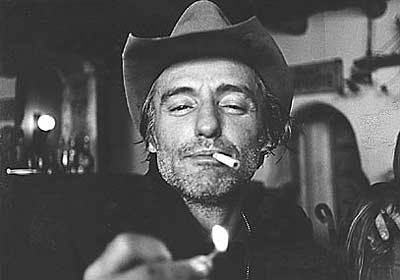
"Think of it as the use of film as film, as an artist uses paint as paint." -- Dennis Hopper

Does Beta like meta? Enough to mention that one time I got tooootally Walter Benjamin-ed so as to suffer through that tedious acid trip sequence from the end of Easy Rider? Enough to pine for a feature-length version of that scene so that it properly recreates the purgatory of an acid trip, ideally with someone who won't stop babbling about how "Jesus was a freedom fighter"? Enough to wish that it also referenced Dennis Hopper's past as an extra in two-bit TV westerns? Or better yet, what if that guy obsessed with Jesus and Billy the Kid was in fact Hopper? Wouldn't that be tidy?

Lucky me, The Last Movie was recently revived at Anthology Film Archives, some two decades on after Hopper's dead career was. When such an announcement is made to acquaintances, the response glibly goes: "Life is too short to watch The Last Movie." Ah, but what is time when the title sequence appears an half-hour in? Hopper is mad about that gear grind, the opening of the film layering the chimes of rock chisels and church steeples so that they too ring like ceremonial bells, like some cosmic cuckoo clock. It's a sound that synch only inside his skull, much like the idea of The Last Movie probably screened better behind his eyelids after licking toads down in Peru than it does in the projection room.

Brother, have I ever been there: imagining the idyllic tomes writ by Adam when in Eden; the softcore papyrus destroyed in the Library of Alexandria; the galleys of Benjamin's Arcade project; the lines that Virginia Woolf wrote on the surface of a lake with rocks in her pocket; the slam poetry Sylvia Plath recited between huffs of gas; the Beach Boys' SMiLE; the portraits you scrap and lug to bonfires; the transcribed pages of babble and energetic scribbles as glimpsed from the heights of mental pinnacles that are untenable in this world. Moonlight turns to butter in your hands; heavenly messages transform into earthly jive.

Hopper surrounds himself with the stoner rollcall: Peter Fonda, Dean Stockwell, Karen Black, Kris Kristofferson, all hang and hanger on at the orgy...er movie. Amorphous, abstract movies don't bother me: I can lock into dreamtime and maintain if they can, but somewhere along the way, the plot haplessly lost, Hopper attempts to scrape one together. It only turns the Acapulco Gold to lead, weighing The Last Movie down by trying to go straight with some lost gold, digging some Sierra Madre along the way. It only makes the trip that much more of a bummer.

Movies rip holes in the spacetime fabric, create purgatories separate from time, loop without end, and are stocked full of replicas that repeat, re-enact like phantoms do, no longer aware that they are dead. The director acts as high priest, as human conduit for the demigods. Hopper digs all that and reveals such gnostic truths to the movie-going audience. But he then proceeds to get high on his own supply of the sacrosanct sizzurp. "I got plenty in my pants and plenty in my pocket," he slurs at one point. He teaches the natives how to throw John Wayne punches, but they want the real thing: real blood, not karo syrup, real sacrifices, not stuntmen. He can't give that to them and he can;t give that to us. They surround themselves with remnants of Hollywood: bamboo boom mics, paper mache cowboys, phony ponies, until the plywood sets become temples. It starts to look like the set of the Killers' video for "When You Were Young." Perhaps it's even more appropo that the hook goes: "He doesn't look a thing like Jesus." I'd want to string him up, too.

Tuesday, August 22, 2006

beta and servants


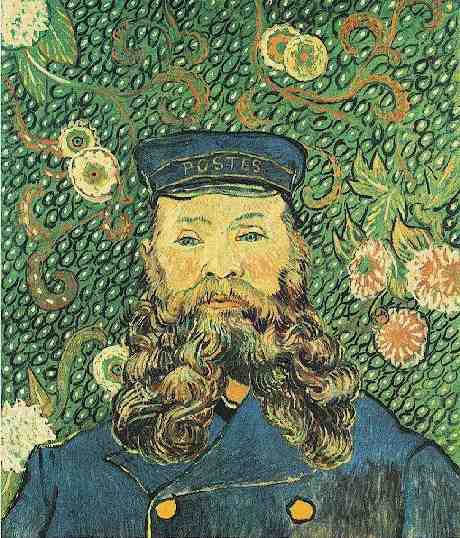
Like some sort of leitmotif in Pierre Michon's Masters and Servants, his narrators often compare paint to honey. Poured gold, pure in sunlight, a viscous substance, an ambrosia, the metaphor sticks. Five stories meditate on the relationship between painter and subject. Starting with Vincent Van Gogh's portraits of Joseph Roulin, Michon muses on a relationship between the two men far from the easel and canvas, be it hunched over glasses with sugarcubes plunked in la Fee Vert, in slurred speech about la republique or an unanswered exchange through the post office. Michon dwells also on Goya, before wading deeper into the despairing nature of painting, to that artistic gesture that fails against the immense face of time, to obscured, non-existent artists who are lost to the centuries, their work warped and destroyed by sun and bonfire, by negligence, by simply being. People can get lost, even when set into that amber...er honey of portraiture.

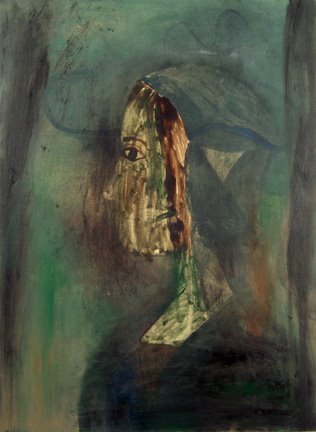
Going to see my friend Jackie Gendel's exhibit recently, her paint feels more like milk, to where faces seem spilt, diluted, either curdling or evaporating, half and half. Her exhibit is a series of portraits, but the faces would never conjure a specific sitter. The glowing review in New Yorker notes a vegetal palette, stating "the underlying subject, however, isn't the figure or its identity but the process of painting itself, and how...subjects are chameleons who can't make up their minds what gender, setting, or century they inhabit."

Her work devastates me the night I finally get to glimpse them. Nevermind that it's one of the most brutal days I've experienced all year-long. Dealing with a sick family member, with a break-up, with a downpour of rain that soaks me through, by the time I arrive, I feel as if the centrifuge in my mind is about to spin me apart. Walking through the rain, everywhere I look, I see fliers that read: "The female is a chaos." Despite being freshly printed, the paper curls and dissolves in the downpour, to where the appropriated Ezra Pound quote reads like some ancient adage.

Inside, soaked, my white shoes taking on the color of my socks, my shirt clinging to my skin so as to become it, I stare into these hanging portraits. They steal my face and I'm lost in the void of them. Veils of brows, cheeks, lips, eye sockets continually peel away, staged characters and multiple personalities at war. My eyes, anxious, terrified, search in vain for a core, a center to it, a familiar face to reassure me, but none comes forth from her canvasses. I need something to hold onto.

It's a centuries-old struggle to exist, to swim up against the tide of rain and to remain in a place, anyplace. Her portraits (which can all be glimpsed here) embrace both disolution and illumination, the rot and evergreen of this skin, these faces. I can no longer recognize anybody in the gallery, even the face of an old lover turns to that of a stranger. Even milk and honey menaces with such a transformation.
(Her) profile was merging with the foliage, enough in shadow that flesh had become light, a ghost or a thing of the trees...the one whose features we recognize -- the full cheeks and mouth, the long neck and throat -- she sank away at the instant of her cry, disappearing, becoming this superlative creature, exalted and ferocious...more imaginary than angels, but like angels was given glorious body and fabular flesh, and like them let out a sort of exaggerated song.

Sunday, August 13, 2006

jandeta

Beta Blog celebrates Jandek's 47th record release.

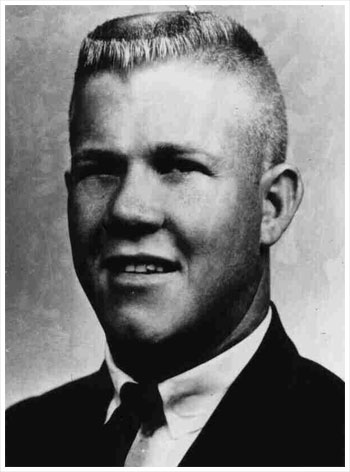
When I lived in Austin, there were no markers to memorialize --much less indicate-- that infamous act of public mass murder commited by Charles Whitman on August 1, 1966, when he shot nearly fifty people, killing 15 of them. An expert marksman, Whitman played Trophy Hunter with the student body: some were shot through the mouth, others through plate glass, between pick-up trucks, or while walking out of class or a store. A pregnant woman was shot through the abdomen, killing her unborn child. Students coming across the freshly killed thought they were witnessing guerilla theatre or some sort of psychology experiment until they too were absorbed into the terror of the reality.

I attended the University of Texas at Austin some thirty years on and knew fuck-all about that day. Sure, there remained holes in the buildings' limestone from rifle shots that had never been plastered over in the resulting decades and the tower itself still bears nodes from where good ol' boys lugged out their pistols and hunting irons to fire back. Unspoken so as to be forgot, silent so as to soothe that disquieting sound that is the echoing crack of a deer rifle's thunder, all but one trace of the man remained: it loomed over the entire landscape, glowed in the darkness of every night, both seen and unseen.

It's only in reading the oral history that comprises the newest issue of Texas Monthly that the day comes back into the light. Having come of age so as to be within the state lines during such atrocities as the Branch-Davidian Compound killings, the Luby's Massacre in Killeen, Texas, such public mass murder (to say nothing of the words "going postal" entering the vernacular) shockingly enough seemed normal in that state. Despite being knee-deep in the bloody mud of Viet Nam, the quaint smalltownness of Austin that is evoked herein is almost unimaginable. It tells of a time before EMS, before SWAT teams (the transportation of the dead was still handled by funeral parlors; tactical police teams were basically invented in the aftermath of Whitman). The Mayberry-ness of the Drag's storefronts (which border the west end of the campus) at that time and are fondly recalled here are as dead as the boho one captured thirty years on by Richard Linklater in Slacker. Both of these previous realities are now polished smooth by the Urban Outfitters and Barnes & Nobles.

"Whitman was blond, good-looking, solidly built. I remember he seemed like a nice, clean-cut, all-American kind of guy," one recounts. Which is shorthand for saying he was a jock-asshole, but one of the thousands that still populate the university. The legend goes that an undiagnosed brain tumor waas the what made him ascend those stairs, though its more plausiable his amphetamine intake had more than a little to do with it. But what makes an All-American man see the world in a new, disturbing, isolated manner? What makes him create his own harrowing universe where he is the only inhabitant, the only assailant, the lone gunman?

Portrait of Whitman as a Young Man.

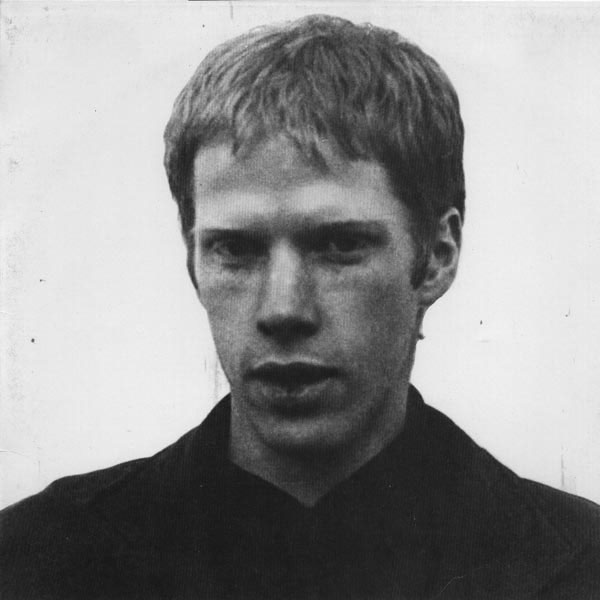
Seven years previous to the exact month, Texas Monthly ran an article about that enigmatic figure who still haunts the subconscious of Texas music, Jandek. Read about his legend elsewhere, or else watch Jandek on Corwood, but know this: music is not public, but extremely private; it grows and festers inside your skull. At that time, it was a shock to the esoteric music community of Texas that some blonde chick, as oppposed to some bespectacled cllector scum, had tracked him down and (gulp) had a beer with him. He lives as an anonymous normal businessman in Houston: black tie, black suit, with no explanation for the madness of the music that results, save that it's kin to growing snap peas. It made Charalambides' Christina Carter weep.

In much the same way that the ghost-white cassettes of Daniel Johnston floated at the periphery of the memory of Austinites, revealing to those with ears this devastating world that almost anyone could fall into if they but stepped towards the monolith, it was the same for Houston's denizens. One musician friend recalls flipping through record after record of this shirtless, bony man, seeing this parallel world evoked in blurry Kodachrome of pork-chop portraiture, backyards, wood-plank houses, cheap crepuscular drum kits, yet always flipping past them. And as Dante has Beatrice and Johnston has Laurie, Jandek has Nancy.

It would be tidy to suggest that in the forty years since the Whitman shootings there, have been forty Jandek records, except that with the release of Glasgow Monday/ The Cell, Janky's now on his 47th, a double disc of piano and whispers, contrabass and tuned toms. Perhaps he aims instead to make as many records as there were bullets that day?
He was one of those guys who got red-faced when he was upset, and he was very flushed when he walked in the door. He was carrying an architectural drawing that I suppose he wanted to show me, but the moment he saw that I had a baby grand in my living room, he dropped his papers, sat down, and played “Claire de Lune.” It’s a fairly tough little tune to play, but he did it beautifully. Then he played something else, though I don’t remember what. When all that red had drained out of his face, he stood up. I said, “Well, I’ll see you in class tomorrow, Charlie.” He said, “Okay,” and left.
Reading the Whitman article by day, I screen the DVD release of Glasgow Sunday, his live public debut, in the night. The thought that there would ever come to pass a time when there would be a concert video of Jandek seemed as likely as meeting your own skeleton. Never shall that twain meet. And yet, that skeleton stands before us now, a face to our own mortality. Its bones clang, both heard and seen. The warm flesh that is music is riddled now with worms, hanging from those arms.
In early September of 1961 he was standing on the seventh-floor balcony of the Goodall Wooten dorm, looking at the Tower, when he turned to a friend and said, “You know, that would be a great place to go up with a rifle and shoot people. You could hold off an army for as long as you wanted.” He wasn’t like you or me; instead of seeing the Tower, he saw a fortress. Instead of rain spouts, he saw gun turrets.
Finally witnessing this wraith-like figure, so unknowable yet familiar after decades of seeing his face on records that accrue and read like so many "Missing" bulletins on a curdled milk carton, like an innocent time killed on scalding hot pavement, he appears ancient, ageless. When he strums that first black note here, making adepts like Richard Youngs and Alex Neilson scurry to keep up with him, Jandek is resurrected as the last of the Texas bluesmen (or at least the dessicated corpse of Stevie Ray Vaughn). His tuning untempered, sensical and orderly only in his mind, the arrythmic tick of his heart untappable by others, his band scrambles to tie the skeleton back together. If Mance Lipscomb or Lightnin' Hopkins had played after their skin fell off the bone, it would've sounded as prophetic as Six and Six. The difference being that when Jandek saw a guitar, he saw not an instrument to affirm life (and the blues do embrace and celebrate this earth), but something that instead resounds with encroaching death, an instrument that is a wooden box, as hollow as its occupant.

Friday, August 11, 2006

beta renovatur

Giacinto Scelsi - Natura Renovatur
My last piece with Lindsey Thomas, my editor in Minneapolis, regarding a figure I'd dreamed of writing about for years. If it's my last ride, it was a sweet one.

Rub'n'Tug - Campfire
Unfortunately, there was no room to insert the word "key" into "bumping'n'grinding," but I guess that it'd just make for a redundant coke joke.

Howard Tate - A Portrait of Howard
If only I had kept in mind Howard's maxim to "get it while you can," perhaps my heart wouldn't be in such a state.

Wednesday, August 02, 2006

betiver

Dig the Vetiver "box set" in the back.

Vetiver - Find Me Gone

Two recent gospel comps on Soul Jazz and Numero Group that allow me to quote Mike McGonigal and make Jesus jokes, but not the other way around.

Phi Ta Khon: Ghosts of Isan
Mark Fosson - The Lost Takoma Sessions
(scroll down)

As my Vetiver piece no doubt attests, I have surprised myself by being wholly impressed with the newest. This after finding the first album ho-hum and subsequently missing Cabic's set at the Bowery. It probably didn't help matters that I detested co-hort Devendra Banhart's last one (and let's not mention the reggae 12"), but the craftsmanship and interplay here is delectable. And rather than being like a hairshirt, Cabic's increased Bolanisms are as comforting as an old, threadbare tee, breezy, worn, but perfect for the summer. Almost everyone I've chatted to about this album (meaning Grizzly Bear and uh...Chris Robinson) also digs it, so it's not just the bourbonade talking here.

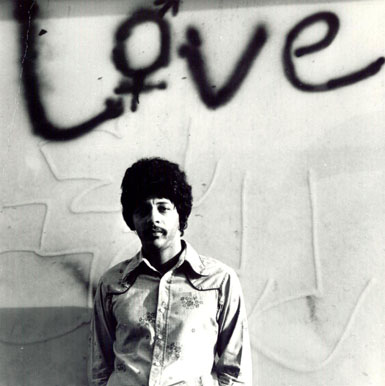
And do I ever feel foolish for missing all fourteen of those "Forever Changes performed in its entirety" Arthur Lee & Love gigs that came through the past five years or so. Maybe I should've gone to Os Mutantes to bathe in such faded light, too, lest it extinguish on this earth? Yet missing Arthur feels like part and parcel for the Love experience. Unappreciated (or should it just be unrequited?), Forever Changes was lost on ears with its ellipses, syncopes, word games, ever-sprawling California roads and open-ended forever chord changes. MacLean was cold in the ground by the time of MOJO's black magick revival, and did they ever unearth Johnny Echols? Either way, a bummer in the summer...

Monday, July 31, 2006

beta clips


The Corrupted - El Mundo Frio

CSS - Cansei de Ser Sexy

A last minute feature on Ben Chasny/ Six Organs of Admittance. The final quote has resounded with me recently, as I think and act upon my own art. While I often think of the work as being about preservation or setting into amber thoughts and experiences, perhaps it really is an exorcism, an extraction. What's the quote about letting out that which resides inside you so that you may live? And if it is not freed, then that same force will destroy you?

Thursday, July 27, 2006

beta nice up de dub


On The Congos and Friends, African Roots, and the Rhythm & Sound Remixes

On the Jamaica to Toronto compilation


When I was out in Portland, on a day touching 102 degrees, Mike McGonigal and I agreed that the only bearable music in such heat radiates from the isle of Jamaica: ska, rocksteady, dub, roots reggae. Now back in New York, I dust off the discs I have accrued for such dog days and spin them in the properly humid hell of Babylon, my face holding beads of sweat races. Somehow, my body heat is tempered, assuaged and cooled by discs like Barrington Levy’s criminally unreleased sessions with King Tubbys, Blackbeard's brain-melting dub sets like Strictly Dubwize and the absurd I Wah Dub, Junior Murvin's epochal Police & Thieves, the forthcoming Noel Ellis showcase that Light in the Attic is putting out, among innumerable others.

Funny how different the dub sounds when it does not emanate from the isle of Jamaica. Even as I argue about how dub music can suspend the spacetime continuum in the Stranger piece, you can immediately hear when the dub booms out from another locus. Sure, Wackies crumbling showcases make heads imagine what the Black Ark would sound like had it not burnt to a crisp, but that grit and soot, those cymbals like steam blasts, the percussion like steel wheels, those oily puddles of bass and snare could only come from a place as filthy as NYC. England's dubs, be it lovers rock or the whacked-out experimentation of On-U Sound's Adrian Sherwood and Dennis Bovell, are instantly identifiable with their Englishness, neatness, and crisp production techniques. No baking the tapes in the razor grass and cane or blowing marijuana across the oxide here, but maybe a splash of tea on it.

So the reggae of Toronto is particularly beguiling to hear now. It's hard to pinpoint, be it the unearthed scene that LITA is reissuing or else those saccharine strings that Studio One legend Jackie Mittoo glopped all over his joints (to reach out to Canuck heads like the MacKenzie Brothers), to understand what makes the sound so singular, but the dubs made by people like Oswald Creary and Jerry Brown are distinct. They got that gluey bass down, to where when Mittoo was doing a session up in London, he got on the horn to try and capture that bass sound that Brown could get at Summer Sound Studios. Yet the Canadian joints couldn't get airplay, to where, as Jerry Brown told me, they would write on the label "Made in Jamaica" so as to dupe the DJs into some spins. It certainly helped them break "Rockin' Universally." And yet the dubs are imbued with the quicker metabolism of northern big city life; biorhythms move quicker, something that the dub can't help but to catch in its stickiness.

Wednesday, July 26, 2006

radio beta

On the Beta radio yesterday, driving to the house of god:

Nelly Furtado "I'm Loose"
This is some crazy on-air joint from a 6CD set of every take on what would be shoved down our goddamned throats in '06 as the summertime jam "Promiscuous." On the original, Furtado mewls the Iggster's original words about riding along on a big fat weenie that's slick and greasy. Fuck, I'm sick of this mash-up. I may as well listen to it 30 times in a row on one CD, as that's what it's like on the dial.

Whatever that Cam'ron and Lil' Wayne joint is where they hang like scarecrows geting some brain. Rote and phoned in, but whatevs.

Supertramp "The Logical Song"
The co-pilot gushes aloud about what the hell happened to Supertramp. "I was just talking about them at my buddy's barbeque last weekend." He swears they were "so huge" back when. "And wait, this is the best part." He cranks up the volume as the wonky sax part kicks in, suddenly realizing I'm in a van full of rockists. But I wait for it and then there it is: these bizarre bleeps right in the middle of the brass wailing. "It's the sound of one of those Collecovision football games," he tells me. I want to make it my ringtone.
Roberta Flack and Donny Hathaway
It's what the God listens to.

The best story R. Allah tells is a story about his mother being a singer, and his aunt, R. Brown. He would watch her get ready for a show at the Cotton Club, sewing up her gown and placing sequins on it and her shoes. "I'd just be eating Slim Jims watching her prepare. You'd have never known she was about to go perform, just cool as a cucumber. "

New York Dolls "Personality Crisis"
Almost swerve off the road into a pine tree when I hear the New York Dolls on rock radio. Admire how ragged and rasped Buster Pointdexter sounded back then before his sex change, as both the band and my vehicle careen around in high hills. S/He sounded ancient back then, which explains how this also fits in with the whole Harry Smith project as well. And then the thirty-year-old fishnets shred and I realize that the Dolls are live in the studio tearing into it. I really shouldn't be behind the wheel now. The on-air personality gushes that you can hear that the Dolls are "just having fun up there."

Thursday, July 20, 2006

beta pics

Since these thingys are worth a thousand words, it means it should make up for weeks of lame updates, I reckon (as well as showing off the new camera I had to buy on vacation):


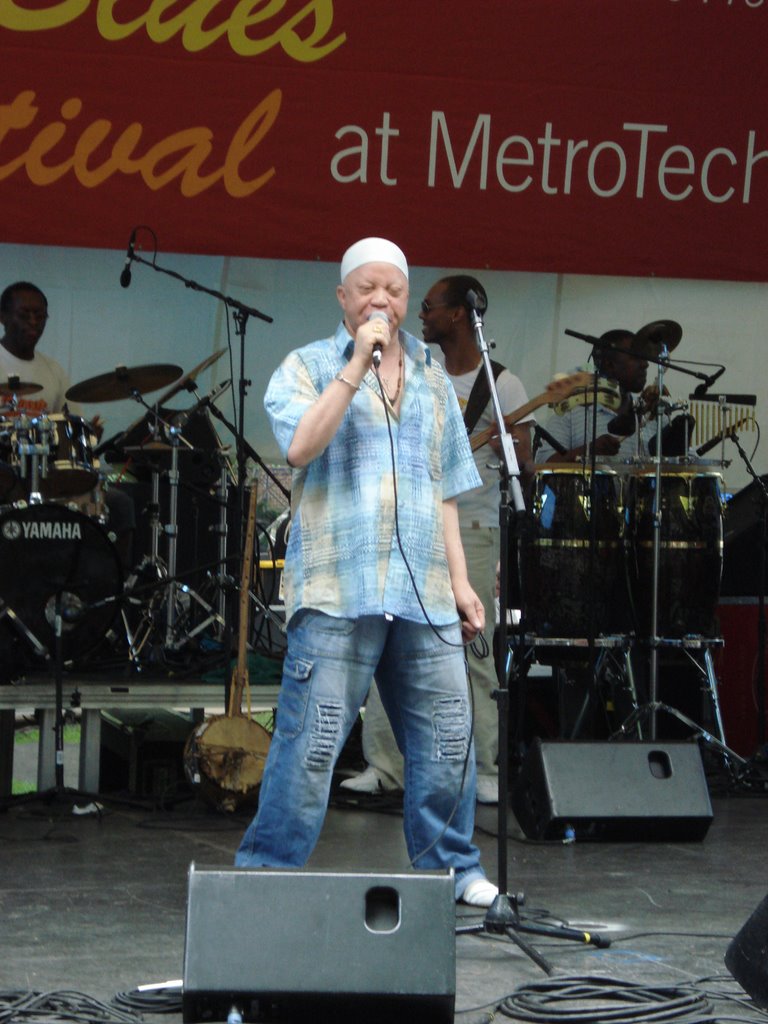
Salif Keita at Brooklyn Metrotech, delivering an exquisite set of Malinese classics for all the grandmothers, little kids, this one mother rubbing her pregnant belly in tune to the beatific beat, and the baldheaded freaks in attendance.


Paintings at the Disjecta loft space in Portland, Oregon. It will be the site for the Mike McGonigal-curated Halleluwah Fest come early September, featuring Vashti Bunyan, Sir Richard Bisop, Deerhoof, and others. Should be sweet.


Oren Ambarchi, Boris, and Sunn O)))

Wednesday, July 12, 2006

beta clips

Ugh, I know, I know, this really has just been turning into a 'clips' site for the past few weeks, hasn't it?

Syd Barrett obituary

Oneida - Happy New Year

This Heat - Out of Cold Storage

Thursday, July 06, 2006

Wednesday, June 28, 2006

beta kills pigs, cops, vegan loaves

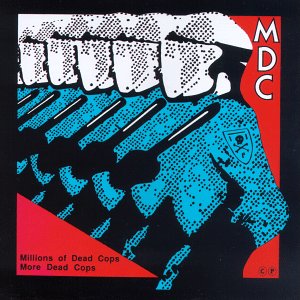
The legendary hardcore band, Millions of Dead Cops! No, really! At a vegan potluck!

There have been two occasions where I almost moved to Portland, Oregon; I may move here yet. It helps that every time I visit the Pacific Northwest, the weather is beatific, almost staggering in its clarity, the sky an impossible blue. This go-round, it really is staggering, as global warming makes the place resemble Texas. Today, it nears 100. Tomorrow it will touch 102. The highway sizzles, windows rolled down to let the hot asphalt winds whip across us as we ride. It evokes the classic Texas roadtrips that we used to take.

Upon arrival in Portland, we decide to visit some old Texas friends. Unable to realize their dreams of manning a deli in New York City, they now run a vegan bodega in SE Portland. Food Fight, scarcely two years on, has grown into a nexus for varying scenes, causes, and it looks like they have created a strong base for themselves, which thrills me to no end. A grocery store that stages reading and rallies while also stocking every sort of mystery non-meat you can imagine.

A recent cause involves raising funds to pay for the ever-mounting legal fees for the Shac 7, who stand to face an endless federal trial as 'terrorists.' I won't go into too much detail here, especially when you can read more about their plight here, but it realizes the horror visions of Kafka (must admit that reading W.G. Sebald's Vertigo has been putting me into a K-hole recently). For those that think that terrorists only exist beyond the borders and wear turbans, the Christian Fascists would like you to reconsider and remain silent, which only helps them crucify harmless citizens who merely posit ideas on the web. Soooo...back to the music, then.

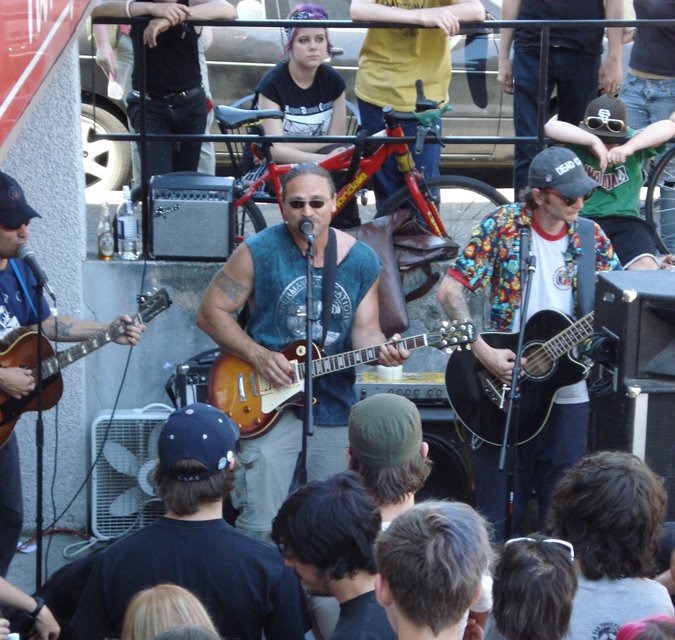
On this day, there's a huge freak scene happening at Food Fight. We make our way through a bizarre throng of anarchists and ladies with faded facial tatts, and only inside do I realize that we are in the midst of a hot and sweaty vegan potluck. Anarchists are in muumuus and there's even a reunion show of hallowed hardcore punk band, Millions of Dead Cops!

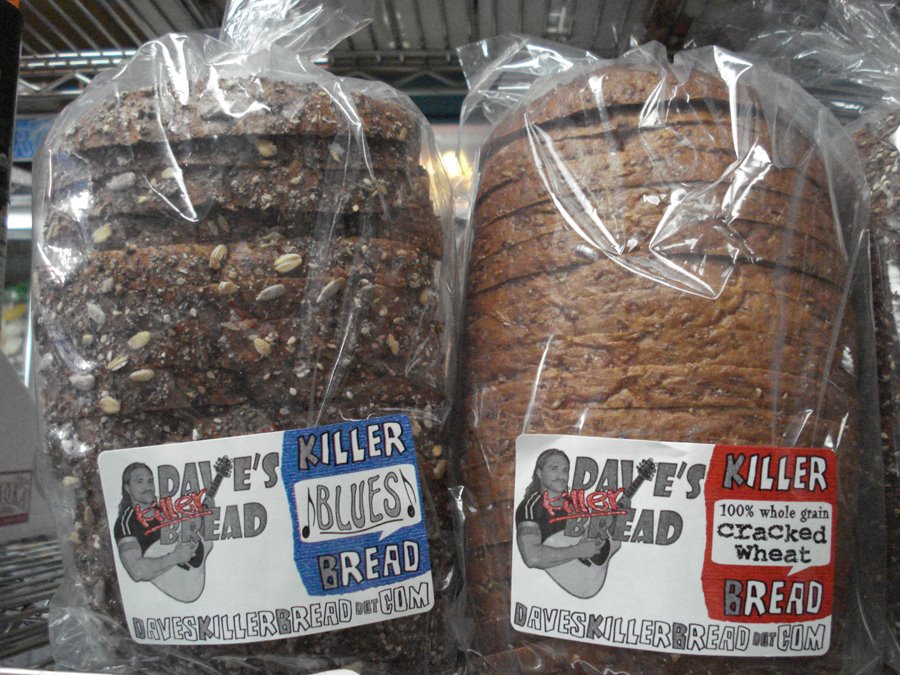
Being a music writer, I've grown jaded with exclusive shows, but this is something else entirely. One Dave is a recovering speedfreak, while the other Dave is a recovering carb addict, baking his own brand, Dave's Killer Bread.

They may also be Bread fans, as this is an acoustic reunion show. I spy a pair of bongos, but don't see them get babbalooed. Instead, they offer whispery, quickly strummed versions of their back catalog and maybe the worst version of "Happy Birthday" ever attempted. Unplugged highlights include "Corporate Death Burger" and "Kill All the Cops." The latter is so catchy that the kids sing it in the car over and over again. It sounds better than both Mr. T Experience and Raffi, while also carrying an important message for all kids to learn.

Tuesday, June 27, 2006

baet simpson

My host Marshall in Eugene, Oregon informs me that it's actually Springfield I am in, and that neighboring Springfield, Oregon is actually Shelbyville. The town square does indeed bear a vague resemblance. Look to the odd pioneer statues of one Eugene Skinner, to the preserved homestead of the man that stands near the Willamette River. By the muddy banks, I fully unravel and feel the vacation kicking in; hours pass just watching the patterns that leaves make in the wind, dappling sunlight and shade across my chest as I sprawl in the soft grasses and read or else stare into the sunny sky. The grass is different in Oregon. (Uh, not that kind.) In Texas, the landscape accosts you like cops do; stickers and burrs gouge, there are sharp crenations of weeds. The blades themselves make you itch. And where there aren't mosquito swarms doing fly-bys, there is always the threat of being brutalized and burned by fire ants. Plopped down in the grass here, all feels benevolent. And I don't even need to pull out a hackey sack or digeridoo.

Staying with Marshall is mind-boggling in a way; he played such a crucial role in my development and appreciation of music when I was sixteen years old that it's hard to believe that were still in touch a decade hence. Were it not for him and his band, El Santo (who will always be my favorite group next to Nirvana), I might've never made the connection that music is actually made by people, and not these distant, untouchable entities.

Guess that is punk rock's most profound lesson. As a child growing up, you usually interact with popular music on a completely alienated, wholly untenable level: here are these peculiarly-dressed people that you will never have a chance to meet. This is what you think rebellion looks and sounds like. But it is a lie outright. You know no one that even looks like them in either your extended family or at your school, despite what the Goths and heshers may appropriate as their 'style.' These strangers make a highly-stylized music that the major label record company then sells you at the mall. I grew up listening to Poison, to G'n'R, to Beastie Boys, but no one in my realm of existence bore even a remote resemblance to these figures.

There's an early piece I wrote for Pitchfork about a lost mixtape that may hint at yet barely makes explicit just how important Marshall (and his immense record collection) was for me. Interacting with him as an aspiring guitarist and music fiend was paramount for making music a part of my everyday existence. There is a flame of gnosis to be attained or to lose to the annihilations of time, and I can think of no other person’s tastes and wide approach to listening that influenced me more in this regard.

So it's strange to be here on vacation, the iPod tucked away, with zero interest in proactively listening to music with Marshall and his family. Sure, I've been digging, thrilled to find this Eddie Kendricks record I’ve spent three years searching for as well as Goblin's OOP soundtrack for Suspiria, but I'm in no hurry to audition them now. Instead, random records plucked at recent yard sales get put on during our days together as we do chores, dress the kids, get ready for bike rides. There’s some fine bluegrass picking record called White Lightnin', a synth-heavy Tony Allen record from '84, some unpronounceable African record with a triangle player, some Mexican kiddie-pop, a schizophrenic Nitty Gritty Dirt Band record before they realized how much they loved Merle Travis, an incredible French accordion-jazz record with an R. Crumb cover, and some Thin Lizzy (okay that's my pick). The kids only want to hear one record though: Mr. T Experience. Listening to Milk Milk Lemonade and this record with a Lite Brite on the cover, seeing how neat-o the red vinyl looks as it spins, it never occurred to me that Lookout!s true record-buying contingency was in reality kindergarteners (hence the longevity of Green Day?). Now I realize this shit's way more fun than Raffi.

Eugene's other claim to notoriety is being the location for Animal House. Of course, said house has been torn down, to where only some dorm rooms remain. The best joke of the whole town though is the location of the Planned Parenthood offices: it's on the corner of 17 & High.

Wednesday, June 21, 2006

reality betas

In a way, I'm glad that the jewelry store isn't open when I rush over there as if to complete all my chores before my flight. My watch battery remains unfixed, my inability to either manage or be on-time has a really great excuse now, even as I try to catch a plane. What it means though is that I can no longer gauge how long we sit on the runway, how long the flight takes, much less how long my enormous layover in Denver is. Too tired to do the math when I finally arrive in Seattle, let's just presume it's been a long fucking day and by not affixing a number to it, perhaps my jetlag won't take hold.

(As life can't help but creep into the work, I realize two upcoming pieces make mention of "time," how these dissimilar artists both disavow and deny it, their music contesting such tides. A lyrical genius says (not sings, mind you): "Time will take care of itself, so just leave time alone.")

Upon landing, I somehow find my way to a Seattle restaurant that does not serve espresso at 11pm, but the sushi is killer, even if they gild the lily a little. Even though I write in up to seven cities, I've really only ever spent time in one of them. Cranking out pieces in a little green room, linking to such articles online, receiving printed checks in the mail, these places just seem like distant clips from Shangri-La or something. Now Seattle is a reality.

Being at a rock show in a new town makes me feel slightly anthropological as I look around at the new settings, the new kids and what their outfits are here. In the daylight, the town seems to really dig shows. Scores of fliers abound, everyone from Prince Paul to Buck 65 to Black Angels to Jose Gonzalez (and holy shit! there's also a flier for Love Battery) flapping along walls and lampposts. Stacks of the Stranger and Seattle Weekly are in nearly every shop doorway. Getting on the bus, I see people reading the weeklies. Perhaps because there is so much more competition for eyes as in New York, where you can also choose between New York, New Yorker, TONY, and (for the sickos out there) NY Press.

For the first time ever, I actually step inside the offices of one of my employers, the Stranger. Dig through the archives to see my words in newsprint; it has that same sort of rush as when I head to the street corner on Tuesday night to find my words in the newest Voice, despite the ink not being fresh any longer.

I'm not here so much for business, but for vacation. I spend the morning taking care of my interview so as to enjoy the sensations of being in a new city. The sky is milky with clouds to where every corner and building front stands out vividly in the skyline. Yes, Seattle is a bustling metropolis, but I notice more space between the noises now, to where once the bus rumbles past, nothing really takes its place. It's an increase of silence, a calm so hard to parse back home. Call it an unclenching on my part, even as I down as much espresso as I can at every opportunity. The only thing that occurs more often today than such sipping is overhearing references to Reality Bites and Singles.

Thursday, June 15, 2006

beta from the canyon

"The Circle Game": A feature on Numero Group's Ladies from the Canyon compilation in LA Weekly

Espers - II

The Black Angels - Passover

And, should you wish to read the piece I wrote about Jackie Mittoo bumping reggae at a mall in Toronto, you can peep the Rick Ross ish of The Fader or else uh...download the rag as a podcast.

Wednesday, June 14, 2006

beta power

In a recent New Yorker article, Samuel Hynes recalls a line Ezra Pound says to him when they happen upon each other in a park: "It's difficult hanging on to the truth while admitting error." It stings especially so as a critic, where your opined words must remain sharp and 'right,' rigid and affixed on a page that floats about in an influx world, where perception necessarily must give and be pliant, ever-changing. I wasn't the only one underwhelmed by Cat Power's The Greatest, finding it to be too shorn of its edges. Where were the jags, the bared edges, the emotional upheavals and artistic crises that flow about her so readily, her destabilized persona suddenly a part of her presentation?

You'd have to be crazy to go see her live though, or at least a sucker for disappointment. If you know anything about her proclivity to melt and disintegrate before her fawning audience, to flub every song, to drop lines, to forget chord changes, to painfully abort the same song ten times in a row, she is already a legend. Snickers no doubt followed the sudden announcement earlier this year that she had cancelled all of her tour dates with the Memphis band due to "health issues." And even with the tour re-scheduled (which was good news for me, as my piece finally ran out in Seattle), I can't help but cop to sniggering in the audience as well. Her reputation preceding her and all that, I still couldn't turn down free tickets to her show at Town Hall.

My friend and I stood outside the doors as the band started up, downing our mixed drinks in the lobby quickly and wondering aloud why we couldn't hear Cat Power at all as the band continued to blare and throb. Only some three songs in did Chan pad across the stage barefoot to sing about how she once wanted to be "the greatest." Resigned to mortality, she flexed, showing off sculpted arms as bodily example, as living proof. That said, her voice was thin and watery compared to the belts of her backing singers, taking some three songs before the sound guy reached some sort of compromise, finally highlighting the fuzz and smoke inherent in her throat while turning down the piquant power of the ladies near the back curtain.

By that time of sonic balance, I was hooked, intoxicated by the pulse of the twelve-piece band and their deft though loose grip, all musical forms understood as they moved with her, accentuating her awkward hip shakes with a more bold and knowing shimmy and slink, which in turn emboldened her, comforted her. The group comprised everyone from pedal steel player Doug Easley and Teenie Hodges to three strings and two horns, two singers. What sounded so polished to the point of listlessness on record brightened under the stage lights. The opulence was undeniable live, and as Chan piped out midway through, she was alive as well. "Sober! Happy!" she intoned, making hand gestures and hopping about like a bunny. Or a teen girl infatuated with "Some Girls" and chicken-walking like Mick before her make-up mirror. She also continually made gestures as to a queef (not sure what to make of that).

When the band finally dissolved and disappeared during "Where is My Love?" (its heartbreaking plaint bittersweet live), Cat Power tiptoed back out in a tight white dress to melt Sandy Denny's "Who Know Where the Time Goes" into a spot-on impression of (who else) Nina Simone's own 1959 Town Hall concert (a poster announces daughter Simone's own impression is forthcoming) with "Wild is the Wind." Perhaps to prove her pianistic powers are crescent, she lets ring into the void between each note her own take on "Dreams" with Elvis's melancholic "Blue Moon" perfectly interloped, the ghost of dead American astronauts alive and a-glow inside her. She even undercuts her own prowess with an off-the-cuff version of "Hit the Road, Jack" that fizzles. The only song of the past is the last, "I Don't Blame You." So she does understand just how she makes us both doubt and believe, making us grapple with such truths and errors with her every breath.

Sunday, June 11, 2006

beta meshes

In Les Blank's documentary on the torturous struggle between man and nature as captured in Herzog's filming of Fitzcaraldo, Herzog reduces the film's essence to a cast-off comment that the natives recognize in the man a kindred spirit, a white man that grasps that it's the everyday life that's the illusion; the realm of dreams is the only true world. (Or, if you're a rock critic, it's like Frank Kogan's assertion that "Elvis never stopped being a truck driver with dreams; the point is he dressed himself in the dreams, not the overalls.")
***
I've been spending time with this girl that I almost didn't realize I cared about. And then, as if waking up one day, it is the only reality. We awaken one morning to admit we've been in each other's dreams. Perhaps her greatest act is that she's even indulged me some basketball TV back at her house. I turn it on just in time to miss one of the last Spurs games of the season, catching only a post-game commentary from a player who I'm loathe to even mention: Kobe Bryant. He reiterates some wisdom that the inventor of the Triangle Offense, Tex Winter, once passed along to him:

"The game hinges on a trifle."

It's not big baskets, rebounds, blocked shots, defensive stops, but rather simple things like deflections, miscues, slipping, bad passes that alter the complexion of a game played between adults irreversibly. As we watch Ernie Johnson, Charles Barkley, Kobe, and Kenny "The Jet" Smith interact, she mentions that the announcers don't like Kenny. She can just tell by their body language. I myself would've never noticed it.
***
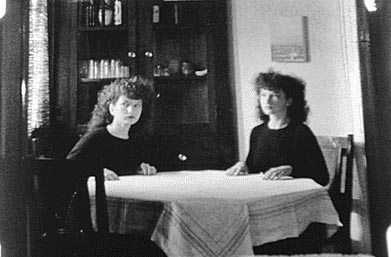
Having had one of those curious moments upon spotting a copy of Maya Deren's Meshes of an Afternoon at her house, to where I cannot recall possession or place for a confused instant, I return to it when I'm back at home. I forgot how much Deren's work inspires and terrifies me to this day, new realities and dimensions unfolding in nearly every frame. My mind cannot understand how she created these films in the forties. How does she replicate the logic of dreams in such a natural manner? Up into the seventies, filmmakers (mostly male) had trouble adequately portraying a fracturing conscience, multiple perspectives, the myriad of lives possible within one body, the dissolution of linear time altogether.

Perhaps it's like that passage of Anais Nin's A Spy in the House of Love that I referenced here, wherein absorbing the reflected light of the moon, a woman becomes open to the infinite possibilities of lovers, of commingled identitites, of multiple dimensions, all a-writhe inside her:
She became certain of myriad lives within herself. Her sense of time altered. She felt acutely and with grief, the shortness of life's physical span...but Sabina, activated by the moon-rays, felt germinating in her the power to extend time in the ramifications of a myriad lives and loves, to expand the journey to infinity.
In Deren's hands, such a dream effect appears effortless: real events recapitulate and mutate, the subconscious pulling at such small matters until they are distended, profound. What seems to be normal and everyday is suddenly plunged into the reality of disorienting, enigmatic, unanswerable dreams. (Forgot to mention that Nin herself appears in Deren's "Ritual in Transfigured Time.")

Quotidian objects toggle between identities: keys are knives, are books, are mirrors. The knife is for cutting a loaf of bread, is for murder, is for the reflection of light, is for the death of self in suicide, is but a dagger of the mind. The inner-eye of Deren continually arranges, deranges, and makes explicit such dreams, its wheels within wheels.
***
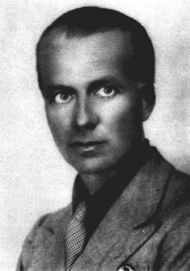
Researching more of Meshes, there is some contention that it may be more the work of first husband, filmmaker Alexander Hammid. And yet his documentary past (and the placcid cat birth caught on his film "The Private Life of a Cat") suggests otherwise. As the rhythms of dreams (and the movement of dancers) become more and more Deren's focus and domain in her other works, the overall feel of the film finally feels as hers, despite Stan Brakhage's assertions to the contrary.
***
It's agonizing watching the Spurs lose, even though I seem to be winning once the TV is off and we're entwined. Just a game, she reminds me. I want to watch the Maya Deren films with her and there's a recent edition of Divine Horsemen that neither one of us has seen, my mind wonders at watching it with her. I flash to her face watching the screen, then my own eyes...but there are more pressing matters to attend to in the present.

On the subway, I catch a glimpse of a girl through glass, a girl that I tried to date right when I first met my friend. At the time, their outward similarities were curiously parallel, and yet as this girl walks into the distance, to the vanishing point (no, there's no black cloak, no mirror face), I realize that in another reality, this would be the girl I watched basketball with instead, that I opened my heart to. My world just took a slightly different bounce. The gestures between two people stack up in one instance, withdraw in another. To think it all started with just an instant of her hand alighting on my chest. How that touch has amplified beyond such an innocuous beginning, how it bounces still, the reality always uncertain.

Monday, June 05, 2006

heep see

My friend and I were truly desperate, trying to find something of value on the satellites come Saturday late night. Infomercials, heavy metal's most metallic moments with the bat blood drained from them, surely a documentary on the Clash was what we needed to feel re-invigorated. Yet the documentary on the band produced for the Documentary Channel makes the band about as boring and pasty as they could possibly be, totally PBS'd, as Frank Kogan might call it.

Okay, so when I was coming up, I kept the Rolling Stone 100 Best Albums of the 80s issue beside me at all times, trying to make my 15-year-old punk self choke down The Indestructible Beat of Soweto and Shoot Out the Lights like healthy heaping helpings of broccoli and spinach. Yet despite the hamburger 'n fries at Number One, I never gobbled down and enjoyed London Calling as much as I was told I would. (If anything, the only Clash record I find to be a guilty pleasure is Combat Rock. To this day, "Straight to Hell" gives me chills, while I randomly find myself screaming out loud, "Hey fellas, Lauren Bacall!" Still not sure what that's supposed to mean, but...)

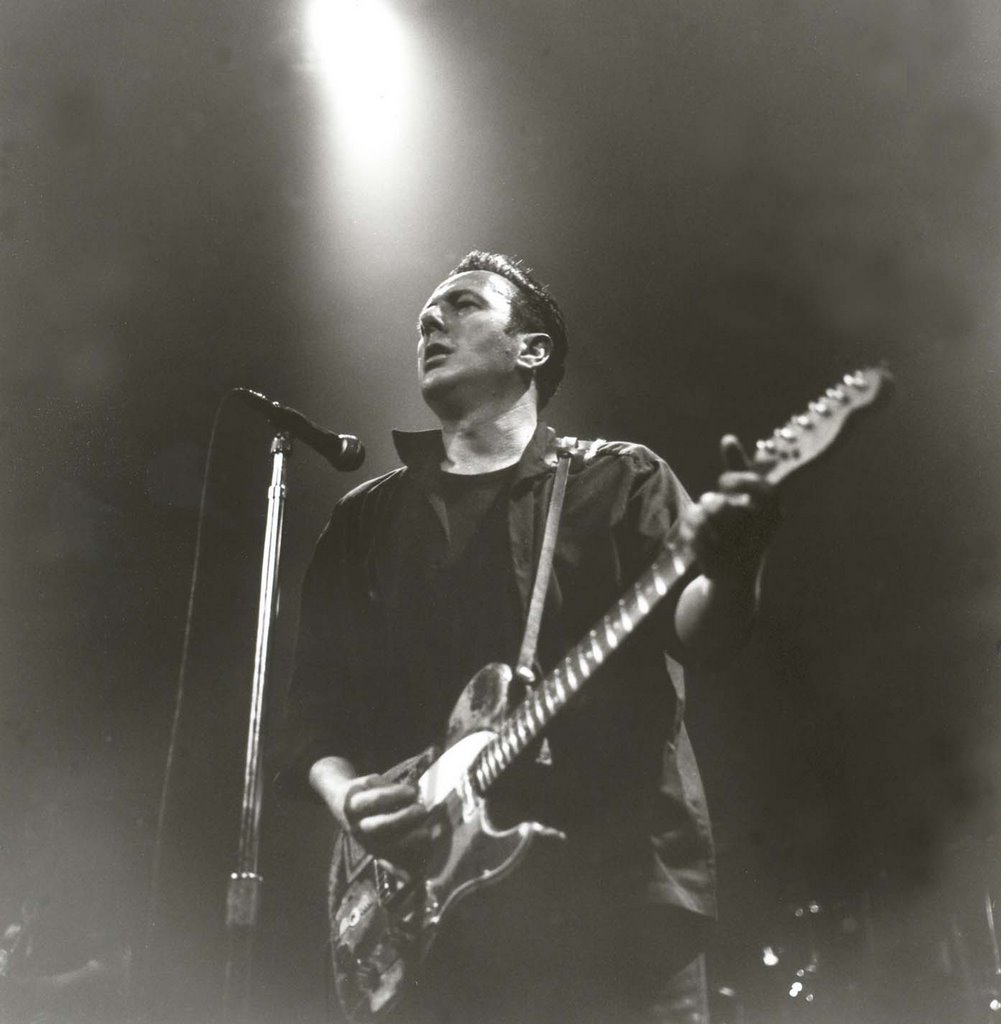
This doc would make anyone hate the Clash though, and it only exacerbates the ridiculous notion of how important it is for white men to grip guitars and "change the world" via playing loud rock in a divebar; is there a more inane sort of legend in music? From the 'scratchy and raw' fonts to the live footage that makes them really indistinguishable from The Who to Def Leppard to Jacob's Mouse to The Arctic Monkeys to (insert angry white UK band here) or... to an outsider, it would prove impossible to explain "the revolution." Not to mention the Clash's attempts at regurgitating their love of reggae so that it clangs out as ham-fisted. Joe Strummer croaks about the brass balls it took for them to do "Police and Thieves"; lord only knows that their youthful metabolism and inability to relax (much less tighten up) make their version border on the intolerable.

It's a shame really, because the story could be important. Just that going into the details of going into the studio on such and such date and playing on a plywood stage is decidedly not. Playing gigs is not what's crucial; it's the culture and community that nurtures such fever dreams and realms of possibilities for a moment that is of interest and importance. What makes ordinary people get up on stage and explode in front of both friends and strangers? (Not sure that it has the answer, but Lipstick Traces does ponder what makes a man start fires.) Bollocks to the story of how the Clash got their drummer; it's the footage of legions of untold folks lost to time mingling and meandering about in torn clothes and jagged black eye-liner that holds our eyes this night. The story of punks interacting with Jamaican culture could be a documentary unto itself; the only titillating bit of the whole program is when the blokes talk about the graphics and iconography of these old Joe Gibbs, Mikey Dread, and Big Youth records.

We switch instead to one of those Time-Life half-hour ads, hoping to find a couple of polyester clips of Harry Chapin, Little River Band, or Billy Paul. Instead, it's the sound of soul, and while watching a clip of Otis Redding, my friend suddenly shrieks: "HOLY SHIT! Did you just see that?" Since she's got the DVR in effect, we rewind back to the footage of Otis Redding going at it with the Bar-Keys behind him. Bent forward, belting in that way of his So. That. Every. Word. Sounds. Capitalized., she pauses it so that we can see it: more than halfway down his thigh, Otis's giant manhood distends his shiny seersucker suit. We laugh uncontrollably, knowing that we'll never hear soul classics like "I've Been Loving You Two Foot Long" and "That's How Strong My Love Muscle Is" in quite the same way again.

Friday, June 02, 2006

beta on the links


Imaginational Anthem in a post-Fahey world

Matmos, Uusitalo, and Matthew Herbert
(oof, the edit decimated both the first and last graph)

Six Organs of Admittance
(at the bottom)